




I ignored the chatbot gold rush for two years because I thought it was just hype. Then I watched a twelve year old build an AI receptionist business that got featured in Business Insider. That was my wake up call.
Let me tell you about the moment I realized I had been sleeping on the biggest opportunity of the decade. I was scrolling through my feed in July 2026 when I came across a story about Mana Jampala, a twelve year old founder who built an AI powered receptionist called Voxa. She launched it in November 2025 to help small businesses field calls and avoid missing potential customers. She used ChatGPT to help write the code before switching to Claude, and now she is running a real business solving a real problem.
If a twelve year old can build a profitable AI chatbot business, what exactly is stopping the rest of us?
The answer is nothing except our own hesitation. The AI chatbot market is exploding in ways that are almost impossible to overstate. The generative AI in chatbots market grew from ten point eight three billion dollars in 2025 to fourteen point six one billion dollars in 2026, a compound annual growth rate of thirty four point nine percent. And it is expected to reach nearly forty eight billion dollars by 2030. The broader chatbot market is forecast to hit thirty two point four five billion dollars by 2031.
More than one million businesses already use WhatsApp and Messenger chatbots to qualify leads, book appointments, and handle customer service. WhatsApp alone now serves three billion users and supports one hundred and seventy five million daily business conversations. Businesses have opened seven hundred and sixty four million WhatsApp Business accounts that achieve ninety eight percent open rates compared to just twenty percent for email.
The numbers are staggering. But the real opportunity is not in the statistics. It is in the gap between what businesses need and what they can afford. Small and medium businesses are desperate for AI solutions but they cannot hire full time developers or pay enterprise prices. That gap is where you come in.
Which Chatbot Should You Build With?
Before you start building anything, you need to understand the tools at your disposal. The landscape has shifted dramatically in 2026 and the old assumptions no longer apply.
OpenAI’s ChatGPT still dominates the market with a forty six point four percent share as of May 2026. Google’s Gemini has rapidly climbed to twenty seven point seven percent, while Anthropic’s Claude holds ten point three percent. But market share does not tell the whole story. Each tool has distinct strengths that make it better suited for different types of chatbot businesses.
ChatGPT is the versatile all purpose option. If you are building general purpose chatbots for small businesses that need everything from customer support to lead generation, ChatGPT is the safest bet. The free tier gives you ten GPT-5.5 messages every five hours, which is generous enough to prototype and test. The paid plans start at eight dollars per month for the Go plan and twenty dollars for Plus.
Claude excels at long form, on brand content and complex reasoning. If you are building chatbots that need to handle nuanced conversations, analyze lengthy documents, or maintain consistent brand voice, Claude is the superior choice. Claude Pro is twenty dollars per month or seventeen dollars billed annually. The Pro plan bundles Claude Code and Claude Cowork, making it particularly valuable if you are building more sophisticated agentic systems.
Gemini offers the deepest integration with Google Workspace. If your target clients are heavy Google users, Gemini’s native integration with Gmail, Docs, and Sheets gives you capabilities that ChatGPT and Claude cannot match. Gemini AI Plus is only four dollars and ninety nine cents per month, making it the cheapest entry point.
Here is my honest take after building chatbots with all three. If you are just starting out and want maximum flexibility, start with ChatGPT. If you are building high end, premium chatbots that require deep reasoning and flawless execution, invest time in learning Claude. If your clients are already embedded in the Google ecosystem, Gemini is your path of least resistance.
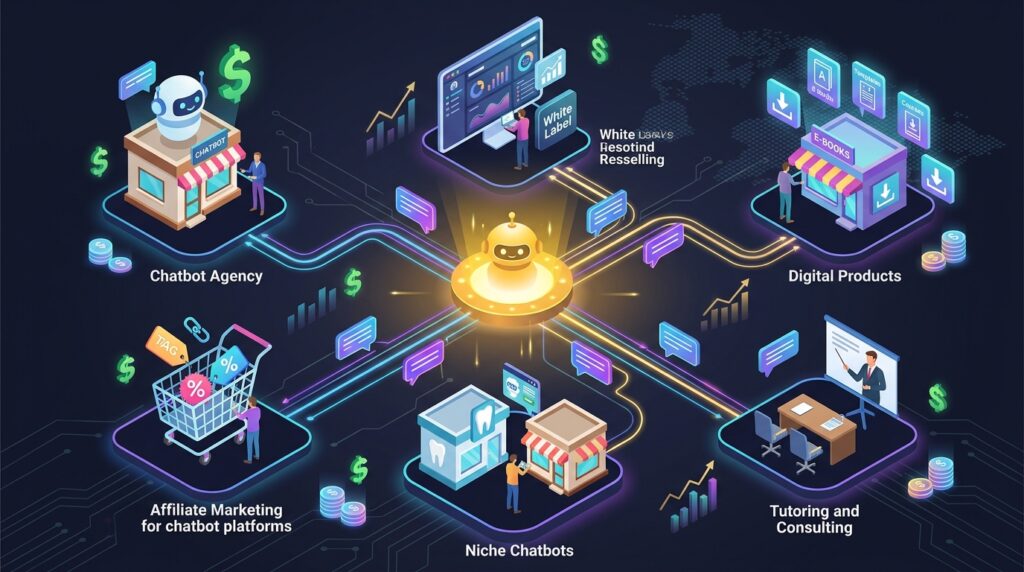
The Six Ways to Make Money with AI Chatbots in 2026
I have tested almost every possible business model involving AI chatbots. Some flopped spectacularly. Others have become reliable income streams. Here are the six that actually work.
1. The Chatbot Agency: Building for Small Businesses
This is the most straightforward and potentially the most lucrative model. You build custom chatbots for small and medium businesses and charge a setup fee plus a monthly retainer.
The setup fee typically ranges from two thousand five hundred to five thousand dollars depending on complexity. The monthly retainer for maintenance and support runs between four hundred and eight hundred dollars. A freelancer with just five clients on retainer at five hundred dollars each is generating two thousand five hundred dollars in recurring monthly revenue before even counting setup fees.
The process is simple. You identify a business with a clear pain point, build a chatbot that solves it, and charge accordingly. One Singapore florist launched an AI chatbot across WhatsApp that saved over four thousand five hundred dollars per month in customer service costs. That kind of measurable ROI makes it very easy to justify your fees.
2. White Label Chatbot Reselling
This is the model I wish I had discovered earlier. Instead of building chatbots from scratch, you resell white label chatbot platforms under your own brand.
Platforms like CustomGPT, Botpress, and Chatbase offer white label options that let you deploy AI assistants grounded in your client’s own data. You charge your clients a premium while paying the platform a wholesale rate. The profit margin is significant and the technical overhead is minimal.
A friend of mine is doing this with CustomGPT. He charges clients four hundred and ninety nine dollars per month for a fully managed AI assistant. His platform costs him ninety nine dollars per month. The margin is four hundred dollars per client per month. He has twenty three clients.
3. Building and Selling Digital Products with Chatbots
Chatbots are not just for customer service. They are powerful content creation tools that can help you build digital products at scale.
You can use AI chatbots to create online courses, e-books, templates, printables, and study guides. Once you create these digital products, you can sell them on platforms like Etsy or Gumroad. The best part about digital products is that you can sell one item multiple times over several years without needing to recreate it.
I used Claude to create a comprehensive chatbot implementation guide that I sell for forty seven dollars. It took me three days to write. It has generated over four thousand dollars in sales.
4. Tutoring and Consulting
The knowledge gap around AI chatbots is enormous. Businesses and individuals are desperate for guidance and they are willing to pay for it.
You can tutor kids and adults in your areas of expertise, using chatbots to generate curricula, practice questions, and study guides. Tutors can make between thirteen and fifty one dollars per hour.
But the real money is in consulting. Businesses will pay premium rates for someone who can walk them through implementation, strategy, and optimization. I charge two hundred and fifty dollars per hour for chatbot consulting and I am booked solid.
5. Creating Custom Chatbots for Specific Niches
This is where the real innovation is happening. Instead of building generic chatbots, you build specialized ones for specific industries or use cases.
A twelve year old built an AI receptionist for small businesses. Someone else built a chatbot that schedules doctor visits and turned it into a one point two billion dollar company. A Singapore florist built a WhatsApp chatbot that saved thousands in customer service costs.
The pattern is clear: identify a specific problem in a specific industry and build a chatbot that solves it. The more niche your solution, the less competition you face and the more you can charge.
6. Affiliate Marketing Through Chatbots
This is a newer model that is gaining traction. You build chatbots that recommend products and services, earning affiliate commissions on every sale.
When customers chat with your AI and receive personalized, contextually relevant offers during the conversation, conversion rates are significantly higher than traditional advertising. AI ad spending is projected to reach thirty two billion dollars in 2026.
I built a simple chatbot that recommends AI tools to freelancers. It generates about four hundred dollars per month in affiliate commissions with almost no ongoing maintenance.

The Tools You Actually Need to Get Started
You do not need expensive software or coding skills to start making money with AI chatbots. Here is the minimal tool stack that I recommend.
n8n is my workflow automation backbone. It is open source and self hosted, meaning you pay five dollars per month for hosting instead of paying per operation like Zapier or Make. I currently have fifty five workflows running on my n8n instance handling everything from chatbot deployment to client reporting.
Botpress is an enterprise grade AI agent platform with a strong visual builder and integrated LLM support. It is built for teams that need intelligent, multi step automation. The platform was named a Strong Performer in The Forrester Wave for Conversational AI Platforms in Q2 2026.
CustomGPT lets you deploy AI assistants grounded in your own data. It offers high accuracy, fewer hallucinations, and straightforward deployment. You can upload your files, customize the look, and deploy with no coding required.
Chatbase is a no code AI chatbot platform that enables businesses to build custom chatbots trained on their data for customer support and lead generation.
For freelancers looking to find clients, Upwork has a thriving marketplace for chatbot developers. Top rated freelancers on the platform are building custom AI apps, RAG powered chatbots, and n8n automations for SaaS teams, law firms, and agencies.
How to Land Your First Client
Finding clients is the hardest part of any new business. Here is the exact strategy I used to land my first chatbot client and how you can replicate it.
Start by picking a niche. Do not try to serve everyone. Pick one industry, one type of business, or one specific problem. I chose e-commerce sellers who were drowning in customer service inquiries. You could choose real estate agents, dentists, restaurants, or any other industry with clear communication pain points.
Next, build a demo. Spend a weekend building a chatbot that solves a specific problem for your chosen niche. Make it functional and polished. This is your proof of concept.
Then start reaching out. Send personalized emails to ten potential clients per day. The template should be simple and direct. Acknowledge the problem they are facing, explain how your chatbot solves it, mention a similar client who benefited from your solution, and ask for a short conversation.
When you get a meeting, focus on outcomes not features. Do not talk about the technology. Talk about the time they will save, the money they will make, and the customers they will not lose. Use numbers and real examples.
Charge a setup fee and a monthly retainer. The setup fee covers your time to build and deploy. The retainer covers ongoing maintenance, updates, and support. This gives you recurring revenue and keeps you engaged with your clients.
The Mistakes I Made So You Do Not Have To
I have built chatbots that failed spectacularly. Here is what I learned from each failure.
Mistake one: Building what I thought was cool instead of what clients needed. My first chatbot was technically impressive. Nobody wanted it. I had built a solution in search of a problem. Now I start by asking potential clients what frustrates them most and build solutions to those specific frustrations.
Mistake two: Underpricing my services. When I started, I charged three hundred dollars for setup fees because I was scared to ask for more. I was leaving money on the table. Businesses are willing to pay two thousand five hundred to five thousand dollars for chatbots that save them hours of work every week. Charge what you are worth.
Mistake three: Ignoring the human element. I thought the chatbot would run itself. It did not. Clients needed training, support, and ongoing guidance. Now I build retainer agreements that include regular check ins, performance reviews, and continuous improvement. This keeps clients happy and generates recurring revenue.
Mistake four: Trying to do everything myself. I built, sold, deployed, and supported every chatbot. It was exhausting and unscalable. Now I have templates, workflows, and standard operating procedures that let me deploy new chatbots in hours instead of weeks.
Real Success Stories to Inspire You
Let me share some real examples of people making money with AI chatbots in 2026.
A twelve year old founder named Mana Jampala built Voxa, an AI powered receptionist for small businesses. She used ChatGPT to write the code before switching to Claude. Her product records restaurant orders, manages missed calls, and writes summaries after each conversation. She launched in November 2025 and is now building a real business.
Two twenty nine year olds built an AI chatbot for scheduling doctor visits. Their company is now valued at one point two billion dollars. They developed a voice AI chatbot that searches physicians’ calendars and matches openings with the type of appointment required.
A thirty seven year old Singapore florist launched an AI chatbot across WhatsApp that saves over four thousand five hundred dollars per month in customer service costs. The chatbot handles customer inquiries, processes orders, and provides support, proving that traditional small businesses can lead in technology adoption.
A business owner with three locations in Sydney implemented an AI tool that allowed them to respond to customers faster and answer more complex questions even outside business hours. It helped them nurture more leads, improve conversion, and reduce customer acquisition costs.
These are not Silicon Valley unicorns with millions in funding. These are ordinary people who identified a problem and built a solution using AI chatbots. You can do the same thing.
Your Action Plan for the Next Thirty Days
Here is exactly what I recommend you do over the next month to start making money with AI chatbots.
Week one: Pick your niche. Choose one industry or one type of business. Research their pain points. Talk to business owners in that niche. Understand what frustrates them and what they are already spending money to fix.
Week two: Build your demo. Use no code tools like Botpress or CustomGPT to build a functional chatbot that solves a specific problem for your niche. Make it polished and professional. This is your sales tool.
Week three: Create your offer. Decide on your pricing structure. Setup fee plus monthly retainer is the standard model. Package your services clearly. Create a simple one page proposal that explains the problem, your solution, the timeline, and the price.
Week four: Start selling. Reach out to ten potential clients per day. Use the template I shared earlier. Get on calls. Listen to their problems. Show them your demo. Close your first client.
The window is open right now. The barrier to entry is still low. Most people think building AI chatbots requires coding skills and it does not. But that advantage is shrinking every day as more people discover these tools. Start now while the opportunity is still there.
Conclusion
Making money with AI chatbots in 2026 is not complicated. It does not require a computer science degree. It does not require thousands of dollars in startup capital. It requires curiosity, persistence, and a willingness to solve real problems for real businesses.
The market is massive and growing fast. The tools are accessible and affordable. The success stories are everywhere. The only thing standing between you and a profitable chatbot business is your own hesitation.
If a twelve year old can build an AI receptionist that gets featured in Business Insider, you can absolutely build a chatbot business that pays your bills.
Pick a niche. Build a demo. Start selling.
The money is waiting.
What niche are you going to target with your first chatbot? Drop me a comment or shoot me an email. I would genuinely love to hear about your journey.


7 AI Side Hustles for Beginners in 2026
Top 5 AI Freelancing Tools That Actually Pay