




Let me tell you about the time I almost gave up on passive income entirely. It was early 2024 and I had just bought yet another course, this one promised automated income with zero effort. The guy on the sales page was sitting on a beach holding a laptop with a caption that read “My AI does the work, I just collect the checks.” I was completely hooked. I paid the four hundred and ninety seven dollars, watched all the videos at double speed, set up the automated system he recommended, and waited for the money to roll in. Three months later I had made exactly twelve dollars and forty seven cents. And I had spent about forty hours troubleshooting broken automations that kept failing at the worst possible moments.
I was furious, not at the course creator although I had some choice words for him, but at myself. I had fallen for the oldest trap in the book which is believing that passive income meant no work at all. The truth is far less glamorous but far more achievable. Passive income is not about doing nothing, it is about doing the work once and letting the system repeat it indefinitely without your direct involvement. The people who succeed at this understand that the upfront investment of time and energy is substantial, but the long term payoff is absolutely worth the effort.
The shift I have witnessed heading into 2026 is nothing short of extraordinary. We have moved past the era of simple chatbots and basic automation tools that could barely handle a single task. We are now in the age of agentic systems, autonomous workflows, and artificial intelligence that can literally run entire micro businesses without any human intervention. What used to require a team of five people can now be orchestrated by a single person with the right tool stack and a willingness to think systematically about their processes. The barriers to entry have collapsed so dramatically that anyone with a computer and an internet connection can build their own automated income streams.
So let me drop the pretenses and give you the raw unfiltered tour of how I am building actual passive income streams with AI automation in 2026. I am going to show you exactly what works, what does not work, and most importantly how you can start building your own systems today without spending a fortune on expensive courses or complicated software. The tools are more accessible than ever before and the knowledge is freely available if you know where to look.

What Passive Income with AI Actually Looks Like in 2026
Before I get into the specific systems I have built, I need to clear up a massive misconception that is holding so many people back. When most people hear “passive income with AI,” they imagine pressing a single button and watching money appear in their bank account like magic. That is simply not how any of this works in the real world and believing that fantasy is the fastest way to get frustrated and quit before you have even started. The truth is less glamorous but far more sustainable and ultimately more rewarding.
Here is what passive income with AI actually looks like in 2026. You build a workflow, which is essentially a sequence of automated tasks connected by triggers and logical conditions that produces a valuable output on a recurring basis. That output could be content, software, data analysis, customer service, or any number of other things that businesses and individuals are willing to pay for. The key is that the workflow runs automatically based on predefined rules and schedules without requiring your constant attention.
The passive part comes from the fact that once you have built and thoroughly tested the workflow, it runs without your direct involvement. You are not trading hours for dollars in the traditional sense. You are trading system design and upfront effort for recurring revenue that keeps flowing even when you are sleeping, traveling, or working on other projects. This is the fundamental shift that makes AI automation so powerful for building wealth.
Let me give you a concrete example from my own experience. I run an automation on my n8n server that generates and publishes social media content across five different platforms. It takes about two hours of my time per month to maintain and improve the system. It produces about forty posts per week across Twitter, LinkedIn, Instagram, Facebook, and Pinterest. If I were doing that manually, it would take me at least ten hours per week which adds up to over five hundred hours per year. That is a ninety five percent reduction in time investment for the same output and that is the power of AI automation when properly implemented.
The key insight I wish someone had told me years ago is that the money is not in the tools themselves, it is in the workflows you build with them. Anyone can subscribe to ChatGPT for twenty dollars per month. Very few people can architect a system that turns ChatGPT, n8n, and a few other APIs into a self sustaining income generator that runs on autopilot. The tools are commodities, the workflows are where the real value is created.
System 1: The Content Automation Engine
This is the system that started it all for me and it remains my most reliable passive income stream to this day. The concept is deceptively simple: create content at scale, distribute it automatically across multiple channels, and monetize through several different revenue streams simultaneously. The execution, however, requires careful engineering and a willingness to iterate and improve over time. I have rebuilt this system from scratch at least four times and each iteration has made it more robust and more profitable.
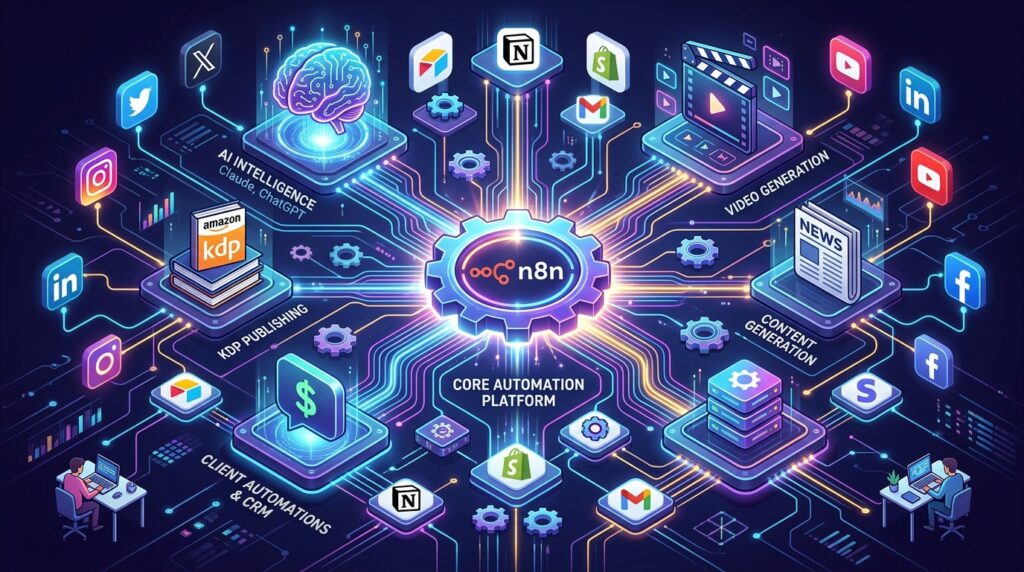
My content automation pipeline follows a logical sequence of steps that all run automatically based on a schedule I set. Every Sunday at two in the morning, my n8n workflow triggers and begins the research phase. It pings Google Trends and various Reddit APIs to identify trending topics in my niche. It filters for topics with decent search volume and commercial intent, basically things that people are actively searching for and willing to pay money to learn about. This initial filtering is crucial because it prevents the system from wasting resources on topics that have no audience or no monetization potential.
Once the topics are identified, the workflow passes them to Claude’s API for the content generation phase. I have crafted a detailed prompt template that includes brand voice guidelines, structural requirements, and specific SEO considerations. Claude generates a complete draft that ranges anywhere from fifteen hundred to three thousand words with proper headings, internal linking suggestions, and a clear call to action at the end. The draft is then run through a second AI for fact checking and consistency verification before being sent to the next stage.
The asset generation phase is where things get really interesting. The workflow uses DALL-E or Stable Diffusion to create a featured image based on the article’s metadata and keywords. It also generates multiple social media snippets including Twitter threads, LinkedIn posts, Instagram captions, and Facebook updates tailored to each platform’s optimal format and character limits. The system even creates a Pinterest pin and a YouTube description for the eventual video version that gets produced separately.
Finally, the distribution phase publishes the content to my WordPress site using the REST API, schedules the social media posts through Buffer or directly via platform APIs, generates an email newsletter draft that I just need to review quickly, and even creates a podcast script that can be fed into ElevenLabs for voice generation. The entire process from topic discovery to distribution takes about four hours of compute time and costs roughly three dollars in API fees. The output is fifteen high quality blog posts per month along with all the accompanying social media content and email newsletters.
The economics of this system are frankly astonishing. The entire operation costs me about forty seven dollars per month to run, which includes five dollars for the DigitalOcean droplet hosting n8n, about thirty dollars in API calls to various AI services, and twelve dollars for the social media scheduling tool. It produces content that generates revenue through three channels: affiliate commissions from linking to tools I actually use and recommend, display advertising revenue, and lead generation for my consulting services from readers who want personalized help. Last month this system generated two thousand eight hundred and forty seven dollars in total revenue which is a six thousand percent return on my forty seven dollar investment. The best part is that I wrote the initial prompts and built the workflow over a long weekend and now I tweak it about once per month. The rest of the time it just runs on its own without any intervention from me.
System 2: The KDP Book Publishing Pipeline
This one came as a happy accident when I was messing around with n8n one weekend trying to see if I could automate the process of writing and publishing Kindle books. What started as a simple experiment has turned into a surprisingly consistent income stream that requires almost no ongoing effort from me. The system follows a similar architecture to my content engine but with a few interesting twists that are specific to the book publishing world.
The workflow begins with niche research using SerpAPI to query Google Trends and identify underserved niches with decent commercial potential. It looks for topics with low competition but high buyer intent, the kind of niches where a well written book can actually rank and sell without needing a massive marketing budget. This research phase is critical because publishing a book into a saturated market is a recipe for disappointment. The system analyzes search volumes, competition levels, existing book prices, and reader reviews to determine whether a niche is worth entering.
Once the niche is selected, the content generation phase begins with something I learned the hard way. Instead of generating one long document, the workflow generates a structured book outline first. It creates a table of contents with logical chapter progression, identifies key concepts that need to be covered, and even suggests potential titles and subtitle variations. This outline is then reviewed by a quality check system before the actual writing begins. The system generates each chapter individually using JSON schemas to ensure consistent formatting and quality throughout the book. This modular approach makes it much easier to maintain quality and catch errors early.
The system can produce a complete one hundred and fifty page book draft in about four hours. The next step is cover design where the workflow generates a professional book cover using AI image generation tools. It creates multiple variations and selects the best one based on predefined quality metrics including composition, readability of text, and genre appropriateness. The cover is arguably more important than the content itself for sales, so this step receives special attention in the workflow.
The final step is formatting for Kindle Direct Publishing and handling the upload process. Since Amazon does not have a public API for KDP uploads, I use Selenium automation to handle the upload process which simulates a human user filling out forms and clicking buttons. This is the most fragile part of the pipeline because Amazon frequently updates their interface, but I have built in error handling and notification systems that alert me if something breaks so I can fix it quickly.
The economics of this system are compelling. It costs about three dollars and fifty cents per book to produce in API calls and infrastructure. I price my books between four dollars and ninety nine cents and nine dollars and ninety nine cents depending on the niche and the length of the content. The break even point is about one point two sales per book. Here is the real magic: because the workflow is fully automated, I can publish multiple books per week without increasing my time investment. Last quarter this pipeline produced four thousand two hundred dollars in KDP royalties on just one hundred and twenty seven dollars in API costs. That is a thirty three hundred percent return and the system is getting better over time as I refine the prompts and improve the quality filters. Not every book sells well, some flop completely, but with the automated niche research I am publishing into markets where I know there is actual demand.
System 3: The AI Automation Agency Playbook
This is the system that pays the biggest bills but it is also the one that requires the most upfront work and relationship building. I stumbled into this by accident when a local business owner asked me if I could make his business run itself. I had no idea what I was doing at the time but I said yes anyway and figured it out as I went along. That first project taught me more about automation than any course ever could.
The concept is straightforward. Small and medium businesses have repetitive time consuming tasks that they cannot justify hiring full time employees for, but they will pay good money for a setup that runs without their constant supervision. I build custom automations for these businesses and charge a setup fee plus a monthly retainer for maintenance and support. The key is identifying the right problems to solve and communicating the value clearly.
Here is the exact thirty day roadmap I followed to build this into a sustainable income stream. In week one I built my arsenal by spending time learning the tools. I installed n8n on a five dollar VPS, learned the basics of MCP, and built my first simple automations like auto responding to customer emails and generating daily sales reports. These were basic but functional and they gave me confidence to take on bigger projects.
In week two I found my first client by picking a niche, which was e commerce sellers, and started reaching out. I sent ten personalized emails per day for a full week. The template was simple and direct. I said “I noticed you are manually handling your order confirmations which is taking up about five hours per week. I build simple AI automations that fix this. A similar client saved six hours per week and reduced errors by ninety percent. Worth a ten minute chat to see if I can help you too?” Out of fifty emails I got eight replies, three calls, and one proposal. The conversion rate was much higher than I expected.
In week three I closed and delivered. I used a simple one page proposal that summarized the problem, the proposed solution, the timeline, and the price. I charged one thousand two hundred dollars for the first project which was an automation that handled order confirmation, fraud checking, and CRM syncing. I delivered it in two weeks and I deliberately over delivered on a small extra feature to build trust and goodwill. The client was thrilled and immediately started referring me to other business owners.
In week four I scaled by asking my first client for a testimonial and a referral. I turned the custom work into a reusable template and listed it on Gumroad for forty nine dollars. Other businesses with similar needs could purchase the template and get most of the way there without paying for custom development. This created a second revenue stream from the same intellectual property.
The economics of this system have scaled far beyond what I initially expected. I now have twelve clients on monthly retainers paying anywhere from four hundred to eight hundred dollars per month for ongoing automation maintenance and support. That is between five thousand and ten thousand dollars in recurring monthly revenue. The upfront setup fees range from five hundred to five thousand dollars depending on the complexity of the automation. Solo operators in this space are reporting eight thousand to twenty five thousand dollars per month within seven to twelve months of starting. The best part is that once you have built a few automations you start to see patterns. You realize that most businesses have the same core problems like lead follow up, customer service triage, order processing, and content distribution. You build templates for these common problems and deploy them faster each time.
The Tools That Make It All Possible
I have mentioned several tools already but let me give you a more comprehensive overview of my 2026 automation stack so you can see exactly what I am using and why. This is the culmination of years of trial and error and I am confident that this combination represents the best balance of power, flexibility, and cost effectiveness available today.
n8n is the undisputed king of my automation ecosystem. I cannot overstate how important this tool has been to my passive income journey. It is open source, self hosted, and infinitely flexible. Unlike Zapier or Make which charge per operation and can get prohibitively expensive as you scale, n8n lets me run as many workflows as I want for a fixed infrastructure cost. I currently have fifty five workflows running on my n8n instance handling everything from content generation to client reporting to social media management. If I were running these on Zapier I would be paying thousands of dollars per month in usage fees. On n8n I pay five dollars per month for the DigitalOcean droplet. The learning curve is real and it took me a few weeks to get comfortable with the visual workflow builder, but the payoff is enormous and once you understand the basics of triggers, conditions, and loops you can automate almost anything you can imagine.
Claude serves as the brain behind most of my automations. The API is remarkably reliable, the output quality is consistently high, and the massive context window of one million tokens which is roughly seven hundred pages of text means I can feed it entire project briefs without breaking context. I use Claude for content generation, code writing, data analysis, and even client communication drafting. The natural language output is so good that I often use it without much editing which saves a tremendous amount of time.
The supporting cast includes Make and Zapier for quick no code integrations when I do not want to spin up a full n8n workflow. Botpress for building customer service chatbots. Apify for web scraping and data extraction. ElevenLabs for AI voiceovers on video content. And Faceless Content CLI for automated short form video creation which turns a topic into a script, voiceover, and video in one seamless pipeline. Each tool has its specific strengths and I use them accordingly.
The Mistakes I Made So You Do Not Have To
I have made almost every mistake possible in this journey and I want to save you the pain of repeating them. My first automation attempt was a monstrous workflow that tried to do fifteen different things at once. It broke constantly and debugging it was a nightmare that consumed entire weekends. Start small, automate one task, get it working reliably, and then add more functionality incrementally. This incremental approach is much more sustainable and less frustrating.
I once published an AI generated blog post without reviewing it properly because I was in a hurry. It contained a factually incorrect statement about a major company and I got called out on social media in a very public and embarrassing way. Now every piece of content goes through a human review gate before publication. The automation does the heavy lifting but I do the quality control. This extra step takes very little time but prevents catastrophic errors.
My first automation product was a tool that analyzed Twitter engagement metrics. It was technically impressive and I was proud of it. Nobody bought it. I had built something cool but not something valuable. Now I start with the problem and work backward to the solution. I ask potential customers what they are struggling with and then build solutions to those specific problems rather than building products and hoping someone wants them.
When I started my automation agency I charged two hundred dollars for setup fees because I was scared to ask for more. I was leaving money on the table and undervaluing my work. Businesses are willing to pay five hundred to five thousand dollars for automations that save them hours of work every week. Charge what you are worth and do not apologize for it. Your time and expertise have real value.
The Future: Where I Am Headed in 2026
Looking ahead for the rest of 2026 my strategy is evolving rapidly. The Year of the Agent is upon us and I am pivoting to capitalize on this massive shift. I am building agentic systems which are AI agents that can operate semi autonomously and make decisions without constant human supervision. These agents can handle customer service, lead generation, sales outreach, and even product development. The potential is staggering.
I am also moving toward a productized service model. Instead of building custom automations for each client I am packaging my most successful workflows into templates that I can deploy rapidly. This reduces my delivery time, increases my margins, and allows me to serve more clients with the same amount of effort. It also creates a library of intellectual property that continues to generate value even when I am not actively working.
And I am doubling down on education. The knowledge gap around AI automation is massive and people are willing to pay for guidance. I am creating more tutorials, more templates, and more coaching offerings because I believe that the future belongs to those who can help others navigate this complex landscape. The tools are changing fast but the fundamental principles of automation remain constant.
Your First Step: A Practical Action Plan
If you are reading this and feeling overwhelmed I completely understand. The landscape is massive and it is changing every day. But here is the thing: you do not need to master everything. You just need to start somewhere and build momentum.
Here is my recommended action plan for building your first passive income automation. In week one, install n8n on a five dollar VPS or your local machine. Build one simple automation like auto posting your content to social media or generating a daily summary email from your calendar. In week two, pick a niche such as e commerce, real estate, content creation, or professional services. Find one business in that niche and offer to build them a free automation in exchange for a testimonial and a case study.
In week three, productize what you built by turning it into a template and listing it on Gumroad for twenty four to forty nine dollars. In week four, reach out to ten potential clients per day using a simple template that says “I noticed you are manually handling this task which is taking X hours per week. I build simple AI automations that fix this. Worth a short chat?”
The window is open right now but it will not stay open forever. The barrier to entry is still low because most people think AI automation requires coding skills and it does not. But that advantage is shrinking every day as more people discover these tools. Start now while the opportunity is still there.
Wrapping It Up
Passive income with AI automation is not a myth. It is not a get rich quick scheme. It is applied systems thinking and it is more accessible in 2026 than it has ever been in human history. I built my first automation over a weekend and it was clunky and broke frequently. But it worked well enough to show me the potential. From there I iterated, I improved, and I scaled.
Today I have multiple automated income streams running on autopilot. They do not make me a millionaire yet but they pay my bills and give me the freedom to work on what I actually care about. The tools are available, the knowledge is freely accessible, and the only thing missing is your willingness to start building.
So what are you waiting for? Build something simple tonight. List it tomorrow. Email ten potential clients this week. I will see you on the other side and I cannot wait to hear about the systems you create. The future of work is automated and it is arriving faster than anyone expected. Be part of that future rather than watching it pass you by.

Other Articles

Top 5 AI Freelancing Tools That Actually Pay
Best AI Tools to Make Money Online in 2026