



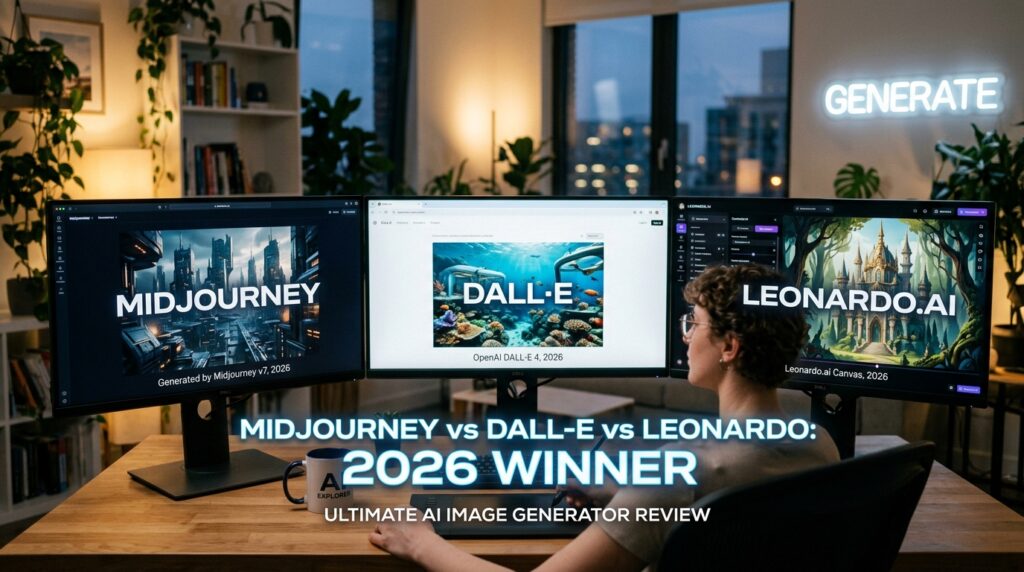
Let me tell you about the moment I realized I needed to get serious about comparing these tools. I was working on a client project that required consistent character illustrations across twenty different scenes. I started with DALL-E because it was convenient, switched to Midjourney when I wanted better quality, and ended up rebuilding everything in Leonardo when I needed actual control. Three different tools, three different sets of outputs, and one very frustrated client wondering why their character kept changing appearance.
That project cost me time, money, and a significant amount of sanity. But it also taught me something invaluable: these three platforms are not interchangeable. They are fundamentally different tools built for fundamentally different workflows, and choosing the wrong one for your specific use case can cost you hundreds of hours of wasted effort.
The landscape in 2026 is dramatically different from even twelve months ago. Midjourney has completely rewritten its codebase with V8, delivering five times faster generation and native 2K resolution. DALL-E has evolved beyond a standalone image generator into a deeply integrated part of the ChatGPT ecosystem. And Leonardo, now owned by Canva with over nineteen million registered users, has repositioned itself around a clear philosophy of human creativity and creator control.
I have tested all three extensively across every major use case you can imagine. Product photography, fantasy illustrations, game assets, marketing materials, character design, and even 3D texture generation. I have generated thousands of images, tracked my costs meticulously, and documented exactly what each tool does well and where it falls embarrassingly short.
Here is the honest truth that nobody wants to tell you. There is no single winner that is best for everyone. The right tool depends entirely on what you are trying to create, how much control you need, and what you are willing to pay. But by the end of this comparison, you will know exactly which one fits your workflow.
Midjourney: The Artistic Heavyweight
Midjourney has long been the gold standard for artistic AI image generation, and 2026 has only solidified that reputation. Most expert reviews still rank Midjourney as the best overall for image quality. It continues to produce some of the most visually striking, artistic output of any generator on the market, particularly for stylized and illustrative work rather than strict photorealism.
The game changer arrived on March 17, 2026, when Midjourney launched V8 Alpha. This was the biggest upgrade the platform has seen since V5 first stunned the creative world. Built on a completely rewritten codebase, V8 delivers five times faster generation, native 2K resolution, dramatically improved text rendering, and better prompt understanding, all while maintaining backward compatibility with existing V7 styles and moodboards.
What does five times faster actually mean in practice? What used to take thirty to sixty seconds now completes in under ten seconds. The web interface has been redesigned to keep up with this speed, making the entire creative workflow feel significantly more responsive. You can iterate through variations at a pace that was unimaginable just a year ago.
The text rendering improvement deserves special attention because this has been a pain point across every AI image model. When you put text in quotation marks within your prompt, V8 renders it with significantly improved accuracy, readable street signs, clean product labels, and legible typography in posters and book covers. It is not perfect yet, but it is a night and day improvement over V7 and puts Midjourney ahead of most competitors on text rendering.
Then came V8.1 on April 30, 2026, which became the default version on June 10, 2026. The model is smarter, more coherent, better adheres to detailed prompts, and renders text better than ever. With HD mode enabled, V8.1 renders at twice the size and four times the resolution of V7 images. Images appear in only four seconds in standard definition and twelve seconds in HD.
But Midjourney is not without its frustrations. The platform dropped its free trial and requires a paid subscription starting at ten dollars per month. The interface, while improved, still feels more technical than its competitors. And the Discord-centric workflow, while enabling rapid iteration, lacks the accessibility of web-based platforms.
For artists, designers, and anyone who prioritizes visual quality above all else, Midjourney remains the undisputed champion. The default renders look more polished out of the box than anything else on the market. But you pay for that quality in both dollars and learning curve.
DALL-E: The Accessibility King
DALL-E, developed by OpenAI, takes the opposite approach to Midjourney. Where Midjourney prioritizes artistic quality, DALL-E prioritizes accessibility and ease of use. It is the tool you reach for when you need an image quickly and do not want to wrestle with complex parameters or Discord commands.
The deep integration with ChatGPT is DALL-E’s killer feature in 2026. Users can describe the image they want, refine the prompt conversationally, and make adjustments without learning advanced prompt engineering. The system automatically generates alt text and metadata, saving marketers an estimated two to three hours per project.
DALL-E excels at prompt fidelity, which is the technical term for how accurately the generated image matches what you asked for. According to Simplilearn’s 2026 benchmark, DALL-E achieves ninety two percent prompt accuracy versus Midjourney’s seventy eight percent when generating product photography or human portraits. This makes DALL-E preferable for advertising agencies needing precise brand alignment.
The platform is especially useful for beginners, content creators, and business users who need quick image ideas, illustrations, or creative concepts. You do not need to understand parameters like aspect ratios, style references, or coherence modes. You just type what you want and the image appears.
But DALL-E has limitations that become apparent as you push it further. While it may not offer the same level of artistic control as some dedicated AI art platforms, its ease of use and ChatGPT integration make it a strong option for fast, accessible image generation. The credit system can be confusing, with different plans offering different allocations and some features consuming credits in ways that are not always transparent.
Pricing is integrated into the ChatGPT ecosystem. The twenty dollar per month ChatGPT Plus subscription includes DALL-E access. There is also a limited free tier through ChatGPT, but it caps the number of generations per day.
For everyday users who need images as part of a broader workflow, DALL-E is the most convenient option. It is not the best tool for artistic mastery, but it is the best tool for getting things done quickly.
Leonardo AI: The Creator’s Control Panel
Leonardo AI occupies a fascinating middle ground. Midjourney still produces better default output and DALL-E is easier to access through ChatGPT, but Leonardo AI occupies a middle ground with more control than DALL-E, lower cost than Midjourney, and a web interface that does not require Discord.
Canva acquired Leonardo in 2024, and the platform now has over nineteen million registered users. The acquisition has accelerated development significantly, and the toolset has grown well past basic text-to-image generation.
The platform now includes a motion module that applies animation to still images, ControlNet-based guided composition that stacks multiple structural layers for precise layout control, negative prompts that let you specify elements the model should avoid, and a 3D texture mapping feature that layers depth onto flat artwork. For game developers, the 3D texture generation feature produces UV-mapped textures like albedo, normal, and roughness maps from text prompts that can be imported directly into engines like Unity or Unreal.
Character Reference is perhaps Leonardo’s most significant feature for professionals. Released in April 2026, it solves one of the most persistent headaches in AI image generation: keeping characters looking the same across multiple outputs. Upload a single reference image, ideally a face shot, set the strength level, and the system maintains that character’s appearance across different scenes, poses, and styles. A children’s book illustrator can keep their protagonist recognizable whether fighting monsters or kicking a soccer ball. A marketing team can deploy the same model across urban streetwear shots and studio perfume ads.
The platform recently unveiled a rebrand under the philosophy “Yours to Create,” emphasizing that human creativity remains central. Rather than framing AI as an autonomous creative force, the rebrand places emphasis on control, experimentation, and creative direction. The visual-first API allows users to design outputs visually within Leonardo’s interface before extracting production-ready code that can be implemented directly into their own products.
The pricing model is remarkably accessible. The free plan gives users a daily token allowance to generate images at standard resolution. Paid plans start at ten dollars per month and increase the token budget, unlock higher resolution output, and remove queue wait times. For creators working on tight budgets, the free tier is generous enough to test workflows and build portfolios.
Leonardo leads in creative control thanks to ControlNet integration, negative prompts, and custom model training. It is the tool for creators who want to push boundaries without breaking the bank.
Head to Head: The Numbers That Matter
Let me break down the comparison in the way that actually matters for your decision.
On image quality, Midjourney scores highest on raw output fidelity. Its default renders tend to look more polished out of the box. Leonardo sits closest to Midjourney for stylized and game-art aesthetics. DALL-E delivers reliable results but lacks the artistic flair of Midjourney or the control of Leonardo.
On prompt accuracy, DALL-E wins decisively with ninety two percent accuracy versus Midjourney’s seventy eight percent for product photography and human portraits. If you need exactly what you asked for, DALL-E is your tool.
On creative control, Leonardo leads with ControlNet integration, negative prompts, custom model training, and the new Character Reference feature. Midjourney offers significant control through its parameter system, but it requires more technical knowledge. DALL-E offers the least control but the most convenience.
On accessibility, DALL-E wins because it is built into ChatGPT and requires no separate account. Leonardo offers a web interface that is intuitive and accessible. Midjourney still requires navigating Discord or a web interface that, while improved, remains more technical.
On pricing, Leonardo is the only one of the three with a permanent free tier. Midjourney dropped its free trial and requires a paid subscription starting at ten dollars per month. DALL-E offers limited free access through ChatGPT but caps the number of generations per day.
On character consistency, Leonardo now leads with its Character Reference tool. Midjourney offers style references and moodboards that help maintain consistency, but they are less precise than Leonardo’s dedicated character tool. DALL-E has faced challenges in this area, making solutions in this space a competitive battleground worth monitoring.
The Verdict: Which Tool Should You Actually Use?
After all this testing, here is my honest recommendation based on what you are trying to create.
If you are an artist, designer, or creative professional who prioritizes visual quality above all else, choose Midjourney. The output is simply more polished, more artistic, and more impressive than anything else on the market. The V8 and V8.1 updates have addressed many of the platform’s previous weaknesses, particularly around text rendering and prompt adherence. You will pay for it, both in dollars and in learning curve, but the results speak for themselves.
If you are a content creator, marketer, or business user who needs images quickly without technical complexity, choose DALL-E. The ChatGPT integration makes it the most convenient option available. You can refine prompts conversationally, generate images, and move on with your work. It is not the most powerful tool, but it is the most practical for everyday use.
If you are a game developer, indie studio, or creator who needs control, consistency, and cost effectiveness, choose Leonardo AI. The platform offers the best balance of quality, control, and price. The free tier is generous enough to get started, the Character Reference tool solves the consistency problem that plagues other platforms, and the 3D texture generation is genuinely useful for game development workflows. The rebrand under “Yours to Create” signals a commitment to human creativity that sets it apart from competitors.
The honest truth is that many professionals use all three. I keep Midjourney for high-end client work where quality is the only thing that matters. I use DALL-E when I need something fast and do not want to leave my ChatGPT workflow. And I rely on Leonardo for projects that require character consistency, game assets, or tight budget constraints.
There is no single winner that is best for everyone. But there is a right tool for your specific needs.
Conclusion
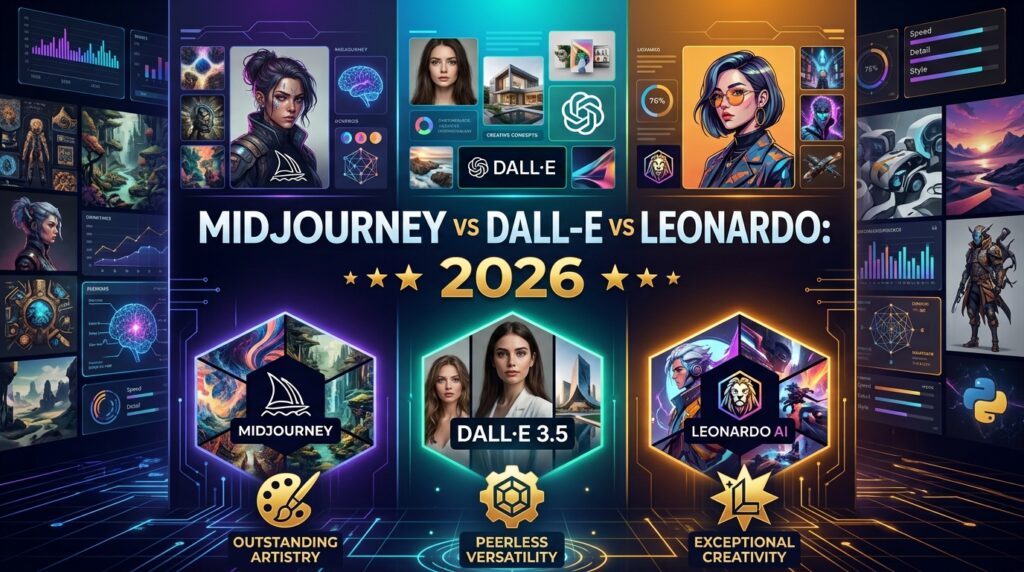
The AI image generation landscape in 2026 is richer and more competitive than ever. Midjourney leads on artistic quality, DALL-E on accessibility, and Leonardo on control and cost effectiveness. Each platform has evolved significantly in the past year, and the gap between them is narrowing in some areas while widening in others.
The choice ultimately comes down to what you value most. If you want the most beautiful images and are willing to invest time and money, choose Midjourney. If you want the easiest workflow and fastest results, choose DALL-E. If you want the best balance of control, cost, and capability, choose Leonardo.
My advice is simple. Try all three. Most platforms offer free trials or generous free tiers. Generate the same prompt in each tool and compare the results side by side. You will quickly discover which one speaks to your creative style.
The technology is good enough now. The only thing holding you back is your own hesitation.
Go make something amazing.
Which AI image generator are you going to try first? Drop me a comment or shoot me an email. I would genuinely love to hear about your creative projects.

Other Articles

The Ultimate Open-Source AI Tools List (2026)
How to Generate Realistic AI Videos (Step-by-Step)