




I spent eighteen months locked into expensive API subscriptions before I realized I was bleeding money. Then I discovered the open-source ecosystem and everything changed. Here is the definitive list of tools that give you enterprise-grade AI capabilities without the enterprise price tag
Let me tell you about the moment I realized I had been throwing money away. I was reviewing my monthly expenses and nearly choked when I saw what I was paying for API access to various AI models. Between ChatGPT Plus, Claude Pro, and various other subscriptions, I was spending over three hundred dollars per month on tools that I could technically run myself for free. The kicker? I was already paying for a server that was mostly sitting idle.
That was my wake up call. I started exploring the open-source AI ecosystem and what I found genuinely shocked me. The quality gap between open-source and proprietary tools had narrowed dramatically in the past year. In many cases, open-source tools were not just comparable, they were actually better for specific use cases. More control, more privacy, and significantly lower costs.
The landscape in 2026 is unrecognizable from just two years ago. Open-source large language models have exploded in capability, with models like Kimi K2 reaching one trillion total parameters. Open-source image generators like Z-Image now rank among the top performers on independent leaderboards. Video generation tools like Bernini are reaching the first tier of quality alongside closed-source commercial models. And the agent frameworks have matured to the point where you can build production-ready systems entirely on open-source infrastructure.
The most important distinction you need to understand is the difference between “open-source” and “open-weight” models. Under the strict OSI Open Source AI Definition, a true open-source model must ship the model parameters, the complete training and inference source code, and sufficiently detailed information about the training data to build a substantially equivalent system. Almost no leading model actually meets this standard. What we commonly call “open-source” LLMs are more precisely “open-weight” models, the weights are downloadable and self-hostable, but the training data and sometimes the training code are withheld. The practical takeaway is that both open-weight and truly open-source models can be self-hosted, inspected, and fine-tuned.
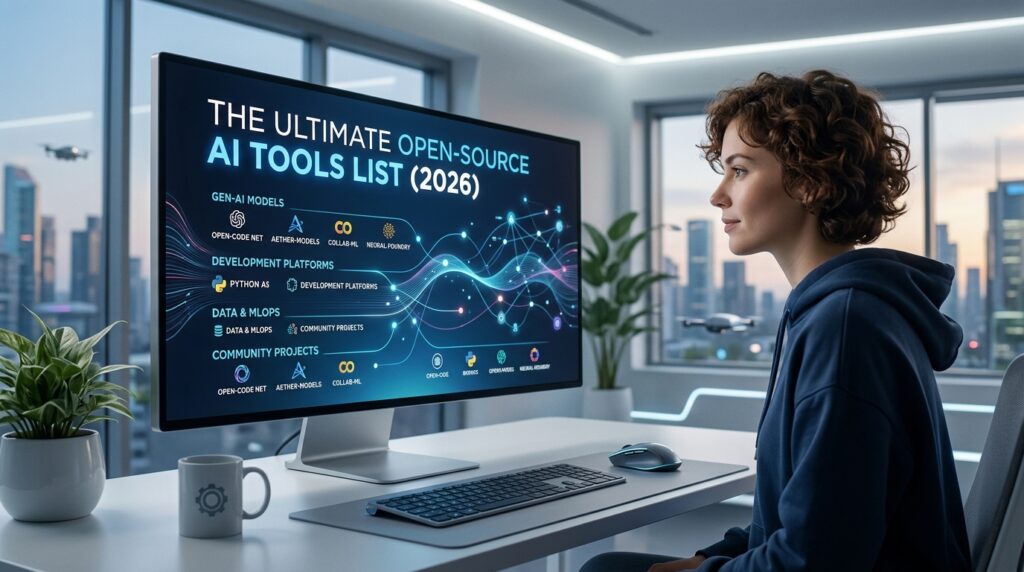
What follows is the most comprehensive list of open-source AI tools I have compiled after months of research and testing. I have organized them by category so you can find exactly what you need for your specific use case.
Open-Source Large Language Models
This is the foundation of the entire ecosystem. Open-source LLMs in 2026 have reached a level of capability that was unimaginable just two years ago. An open-source LLM is a model whose trained weights you can download, inspect, fine-tune, and run on your own hardware instead of only calling a vendor API.
The leading families in 2026 include Qwen3 (Apache-2.0), DeepSeek (MIT), Llama 4, GLM-4.6, Mistral, Kimi K2, gpt-oss, and MiniMax M2. Each of these represents a massive investment in training and delivers performance that rivals or exceeds closed-source alternatives.
Qwen3 from Alibaba has become the default choice for many developers. The Qwen3-Coder-480B variant scores an impressive 69.6 percent on the SWE-bench Verified benchmark, making it one of the most capable coding models available. The Apache-2.0 license means you can use it for commercial applications without restrictions.
DeepSeek has carved out a reputation for exceptional performance with surprisingly efficient resource usage. The MIT license makes it one of the most permissive options in the ecosystem.
Llama 4 from Meta continues the lineage of one of the most important open-weight model families. While the licensing is more restrictive than some alternatives, the quality and community support remain exceptional.
Kimi K2 from Moonshot AI represents a massive shift in the landscape. The model reaches one trillion total parameters with thirty two billion active parameters in a Mixture-of-Experts architecture. The context window ranges from one hundred and twenty eight thousand to one million tokens, giving you enormous capacity for long-form reasoning.
Inkling is a newer entrant that has generated significant buzz. With nine hundred and seventy five billion total parameters and forty one billion active parameters, it ranks among the largest open-source models in the world. It is designed as a broad, balanced generalist rather than a specialized leaderboard chaser.
Command A+ from Cohere positions itself as an enterprise workhorse built for complex reasoning, multimodal and multilingual agentic tasks, all while running on as little as two H100 GPUs.
GLM-4.6 and GLM-5.2 from Zhipu represent the Chinese open-source ecosystem’s continued push into frontier capability. GLM-5.2 reaches seven hundred and fifty three billion parameters.
AMALIA is a fascinating sovereign AI project from the Portuguese government. It is a fully open large language model for European Portuguese, developed as a national infrastructure project.
Instella-MoE from AMD represents a fully open Mixture-of-Experts model trained end-to-end with open-source frameworks. The company is releasing all artifacts for the model, making it one of the most transparent options available.
Mistral remains a favorite for developers who need a balance of performance and efficiency. The French company has established itself as a serious competitor to the American and Chinese giants.
How to Run Them Locally
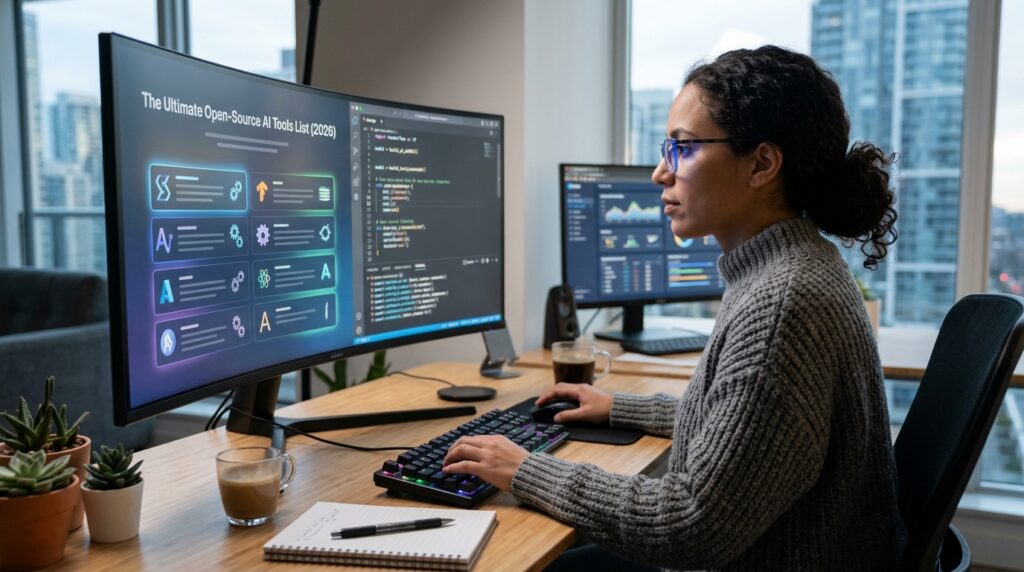
You have several options for running these models on your own hardware. Ollama is the most beginner-friendly option, giving you a simple command-line interface to download and run models locally. For production serving at scale, vLLM and SGLang provide high-performance inference engines. For multi-model routing, you can use an OpenAI-compatible router that lets you switch between models seamlessly.
Open-Source AI Coding Assistants
This is one of the most competitive categories in 2026. Eight open-source AI coding assistants have emerged as serious contenders, each with hundreds of thousands of GitHub stars. The best part is that every single one of them can run local models through Ollama, LM Studio, or an OpenAI-compatible endpoint, making “self-hosted” and “air-gapped” deployments achievable with all of them.
OpenCode leads the pack with an astonishing one hundred and seventy two thousand GitHub stars under an MIT license. It is available as a terminal tool or VS Code extension and supports seventy five plus LLM providers through the AI SDK. If you want maximum flexibility and the broadest provider support, OpenCode is your best bet.
Gemini CLI from Google has one hundred and five thousand stars under Apache-2.0. It runs in the terminal and offers sixty requests per minute with one thousand requests per day on a Google account. The free daily quota makes it an excellent entry point.
OpenAI Codex sits at eighty nine thousand nine hundred and ninety one stars. While OpenAI’s flagship models are closed, the Codex repository provides a robust CLI and IDE experience.
Cline has sixty two thousand nine hundred and ninety six stars and is designed for IDE-native self-hosted deployments. It supports VS Code and JetBrains with Ollama and LM Studio for local models.
Goose is a Rust-based MCP-first general agent with forty eight thousand five hundred and forty two stars. It supports seventy plus MCP extensions and ACP subscriptions, making it highly extensible.
Aider is the most mature terminal-based agent with forty five thousand nine hundred and forty five stars under Apache-2.0. It runs in your terminal and treats git as the system of record. Every accepted change becomes a commit with a generated message, making undo as simple as git revert. For local LLM work in the terminal, Aider is the gold standard.
Kilo Code has nineteen thousand nine hundred and sixty eight stars and supports over five hundred models with bring-your-own-key at provider rates.
Agency-agents deserves a special mention. While not a traditional coding assistant, this fast-growing, MIT-licensed collection of over two hundred specialized AI agent persona definitions has surpassed one hundred thousand GitHub stars. Each persona is a markdown file describing a role, workflow, and deliverables, such as a frontend specialist, a security reviewer, or a growth marketer. You copy these persona files into the config directory of an AI coding tool you already use, like Claude Code or Cursor, and activate any persona in your existing sessions.
A note on Claude Code: The most-starred coding repository, anthropics/claude-code at one hundred and thirty one thousand three hundred and eighty stars, is not open source. The license field is empty and Claude Code itself is proprietary, requiring a paid account. The open-source alternatives above give you similar capabilities without the subscription.
Open-Source AI Agent Frameworks
Agentic AI is the defining trend of 2026. The shift has moved from chatbots to agentic engineering, fueled by open-source infrastructure. The best teams building agents in 2026 aren’t writing prompts, they are architecting systems that plan, execute, verify, retry, and learn.
LangChain is the most established framework with one hundred and twenty six thousand GitHub stars. It provides abstractions for model calls, context management, tool integration, and multi-step workflows. If you are building LLM applications by composing chains, agents, tools, memory, and retrievers, this is your starting point.
LangGraph builds on LangChain’s ecosystem with twenty three thousand stars and introduces stateful, multi-actor applications using explicit graphs. You define nodes, edges, and shared state to control agent execution paths. It is widely regarded as the most production-grade option, with built-in state checkpointing, streaming, and human-in-the-loop support for long-running workflows. Written in Python with TypeScript support, it is fully model-agnostic.
LlamaIndex has forty six thousand stars and is the data framework for connecting LLMs to structured and unstructured data. It provides tools for ingestion, indexing, retrieval, and query orchestration across documents, databases, and APIs. It is frequently used as the retrieval and memory layer in agentic systems.
AutoGen from Microsoft has fifty three thousand stars and is designed for building multi-agent systems where agents communicate via structured messages. It enables agent-to-agent collaboration, tool usage, and conversation-based task decomposition. However, Microsoft has moved AutoGen into maintenance mode, consolidating its architecture into the broader Microsoft Agent Framework.
CrewAI has forty three thousand two hundred stars and focuses on orchestrating role-based multi-agent workflows. You define agents with specific roles, goals, and tools, and coordinate them through structured task execution. It emphasizes clear mental models for collaboration over low-level orchestration primitives. Along with LangGraph, it is one of the strongest entry points for most developers, LangGraph for production-grade control and CrewAI for the fastest path to a working prototype.
Semantic Kernel has twenty seven thousand one hundred stars and is an orchestration SDK for integrating AI into applications using skills, planners, and functions. It provides a structured approach to combining LLMs with traditional software components and is widely used in enterprise and .NET-centric environments.
OpenClaw is an open-source, MIT-licensed personal AI assistant that has grown extremely fast with multiple sources putting it in the three hundred thousand plus GitHub star range. It connects to messaging platforms like WhatsApp, Telegram, Slack, Discord, and Signal, and runs with persistent memory and a skills system for extending what it can do. It is genuinely self-hostable via Docker or npm.
Haystack is an open-source AI orchestration framework for building production-ready LLM applications in Python. It provides modular pipelines and agent workflows with explicit control over retrieval, routing, memory, and generation. Thousands of teams use it to build production AI systems across industries.
Tantra is a simple, minimal, observable, production-ready AI agent framework. It combines simplicity with powerful features including first-class observability, integrated evaluation, and extensible provider support.
Yumi is an open-source self-hosted AI agent framework that provides cross-language tool edges. One API lets AI call functions in any language on any device, supporting Dart, C++, Swift, TypeScript, Go, Java, and C# with the same pattern.
Agno is a lightweight agent framework focused on composability and minimal abstractions. It provides primitives for building agent workflows without enforcing rigid architectural patterns.
Genkit from Google is an open-source framework for building full-stack AI-powered applications, built and used in production by Google’s Firebase. It provides SDKs for multiple programming languages.
Magek is a framework for building event-driven AI-native applications. It helps structure code using event sourcing and runs ambient agents that operate continuously.
Open-Source AI Image Generation
The image generation landscape in 2026 has two clear leaders: Z-Image from Alibaba and Flux from Black Forest Labs. Both are open-source text-to-image models that most teams now evaluate when they want to run image generation without an API subscription.
Flux.1 is a twelve billion parameter rectified flow transformer from Black Forest Labs, optimized for raw quality on complex scenes. The family includes several variants: Flux.1 [schnell] is a one to four step distilled version under Apache 2.0, Flux.1 [dev] is a guidance-distilled version under a Non-Commercial License v2.0 with paid commercial available, and Flux.2 [klein] is an Apache 2.0 distilled version released in January 2026. The flagship Flux.2 [dev] reaches thirty two billion parameters with multi-image reference capabilities. The minimum VRAM requirement for bf16 inference is approximately twenty four gigabytes.
Z-Image from Alibaba’s Tongyi-MAI lab is a six billion parameter Scalable Single-Stream DiT optimized for speed, low VRAM, and native English-Chinese typography. The family includes Z-Image-Turbo, a six billion parameter eight-step distilled model under Apache 2.0 released in November 2025, and Z-Image, the six billion parameter foundation model requiring twenty eight to fifty sampling steps released in January 2026. The minimum VRAM for bf16 inference is sixteen gigabytes, making it significantly more accessible than Flux. Independent benchmarks place Z-Image-Turbo as the number one open-source model on the Artificial Analysis text-to-image leaderboard, ranked eighth overall against closed-source competitors as of early 2026.
Z-Image-Omni-Base and Z-Image-Edit provide generation and editing variants currently in rolling release. The native English-Chinese typography support is a differentiator that matters for anyone creating bilingual content.
HunyuanImage-3.0-Instruct from Tencent is the largest open-source image generation Mixture of Experts model to date. It features sixty four experts and a total of eighty billion parameters, with thirteen billion activated per token.
Qwen-Image 2.0 from Alibaba holds the number one position on AI Arena, the leading blind human evaluation platform, in both text-to-image generation and image editing categories as of early 2026.
AI Playground from Intel provides an open-source application suite for chat, code assistance, document search, image analysis, and image and video generation. It supports Flux.1 and Z-Image models for image generation.
Open-Source AI Video Generation
Video generation has become one of the most exciting frontiers in open-source AI. Multiple projects now offer capabilities that rival closed-source commercial tools.
Bernini from ByteDance is a unified framework for video generation and editing that combines an MLLM-based semantic planner with a DiT-based renderer. The full Bernini release packages a Qwen2.5-VL planner, Bernini planning weights, and Wan2.2 diffusion components in one self-contained directory. On video editing, Bernini reaches the first tier among leading closed-source commercial models in internal arena evaluations based on blind human pairwise comparisons. The model is recommended for complex generation and editing requests that benefit from explicit latent semantic planning and stronger instruction following. A Hopper GPU like H100, H800, or H200 is recommended for best performance.
Seedance 2 from ByteDance has inspired open-source implementations. A beautifully designed, fully-integrated AI video playground built with Next.js serves as a complete, self-contained SaaS boilerplate for generating, editing, and managing high-quality AI videos fueled by Seedance 2.0 and the new Seedance 2 Mini engine, ByteDance’s fast, affordable model at approximately $0.073 per second.
Local Video Gen Studio lets you generate stunning AI video clips from text with no subscriptions, no cloud fees, and no waiting. Built around SANA-WM, a 2.6 billion parameter open-source video model, it lets creators generate 720p video clips from text prompts in minutes. You can process batches overnight and keep everything private with no cloud, no surveillance, and no vendor lock-in.
OpenMontage is the world’s first open-source, agentic video production system featuring twelve pipelines, fifty two tools, and over five hundred agent skills. It handles research, scripting, asset generation, editing, and final composition. The agent builds a corpus from free stock footage and open archives, retrieves actual motion clips, edits them into a timeline, and renders a finished piece.
LeronX Engine is the open-source core of an AI-powered video creation platform. It provides a modular, extensible system that transforms text prompts into fully rendered videos.
Open-Source AI Automation and Workflow
Automation is where open-source truly shines. You can build entire automated businesses without paying per-operation fees that would bankrupt you on proprietary platforms.
n8n is the undisputed king of open-source workflow automation. Think of it like a much more powerful, self-hostable version of Zapier or Make. It combines a visual canvas with custom code, runs self-hosted or in the cloud, and connects to over four hundred apps and fifteen hundred plus integrations. The fair-code platform lets you build and deploy AI agents and workflows on your own infrastructure.
The Self-hosted AI Starter Kit from n8n is an open, docker compose template that bootstraps AI workflows. While not fully optimized for production, it combines robust components that work well together for proof-of-concept projects.
n8n-claw is an OpenClaw-inspired autonomous AI agent built entirely in n8n. It features adaptive RAG-powered memory, skills via MCP templates, expert agents with delegated sub-agents, proactive task management, and media understanding. A fully self-hosted AI agent built on n8n plus PostgreSQL plus Claude, it talks to you via Telegram or HTTP API, builds its own MCP tools, and manages reminders and memory, all running on your own infrastructure. The hybrid search for long-term memory combines semantic and full-text search with entity match, time decay, tags, entity tracking, and source attribution.
Outreach-os is an open-source AI-powered B2B outreach system that handles lead scoring, personalized cold emails, reply tracking, and auto follow-up. Built with n8n, free-tier AI APIs, and Google’s own tools, it does in five minutes what used to take half a day, and runs twenty four seven without you touching it.
Flowise and Langflow are popular alternatives to n8n for visual AI workflow building.
Open-Source AI Infrastructure and Libraries
Beyond the application layer, a rich ecosystem of infrastructure tools makes self-hosting AI practical and accessible.
The Awesome LLM Services list tracks over one hundred and thirty eight LLM services, tools, and infrastructure for running AI locally. All are open-source, self-hostable, and friendly to containerization via Docker or Podman.
The Awesome AI CPU list curates open-source AI projects that run efficiently on CPU with no GPU required. Perfect for makers, indie developers, and local AI experiments.
The Awesome Free AI Tools list includes two hundred and thirty one plus genuinely free AI tools across thirty five plus categories, including real free tiers, open-source projects, and freemium plans that are actually usable.
The Awesome Free Models list curates free AI models, APIs, and tools you can use without paying a cent, with all two hundred and forty five links verified live.
Conclusion
The open-source AI ecosystem in 2026 is richer and more capable than ever before. You can run state-of-the-art language models on your own hardware. You can build production-grade agent systems without paying per-operation fees. You can generate images and videos that rival commercial tools. You can automate entire workflows without vendor lock-in.
The trade-offs are real. Open-source tools require more setup time. They demand more technical knowledge. They need proper hardware to run effectively. The quality gap between open-source and closed-source models has narrowed dramatically, but it has not completely closed.
But for anyone who values privacy, control, and cost-effectiveness, the open-source ecosystem is genuinely compelling. The tools are there. The documentation is improving. The communities are vibrant and growing.
Pick one category. Master one tool. Build something that surprises you.
The only thing holding you back is your own hesitation.

Other Articles

Best AI Agents & Automation Tools for 2026
Midjourney vs DALL-E vs Leonardo: 2026 Winner