




I have spent the last two years helping businesses implement AI solutions. I have seen what works and what does not. I have watched companies waste thousands of dollars on tools that promised the world and delivered nothing. But I have also seen businesses transform their operations with the right tools. Here are the ten that actually move the needle.
Let me tell you about the most expensive mistake I ever made. A few years ago, I was consulting for a mid-sized e-commerce company that was drowning in customer service requests. They had a team of twelve people handling emails, chats, and phone calls, and they were still falling behind. I recommended a fancy AI chatbot solution that cost them fifteen thousand dollars per month. It was a disaster. The chatbot could not handle complex questions, it frustrated customers, and they ended up hiring even more people. The whole thing was a complete waste of money.
That experience taught me a valuable lesson. The most expensive tools are not always the best ones. The tools that look the most impressive in demos are not always the ones that deliver results. The best AI tools for business are the ones that solve real problems, integrate seamlessly into existing workflows, and deliver measurable ROI.
The business AI landscape in 2026 is dramatically different from even twelve months ago. The tools have matured. The integration capabilities have improved. The pricing models have become more accessible. But the biggest shift is that AI is no longer a novelty. It is becoming embedded in how businesses operate. Gartner predicts that by the end of 2026, forty percent of enterprise applications will feature task-specific AI agents. The question is no longer whether to adopt AI. It is which tools to adopt and how to implement them effectively.
Here is the honest truth. Most businesses are still figuring out how to use AI effectively. The gap between the tools that exist and the tools that businesses actually use is enormous. The companies that are succeeding are the ones that are strategic about their AI adoption. They are not buying every shiny new tool. They are identifying specific problems and finding AI solutions that solve those problems.
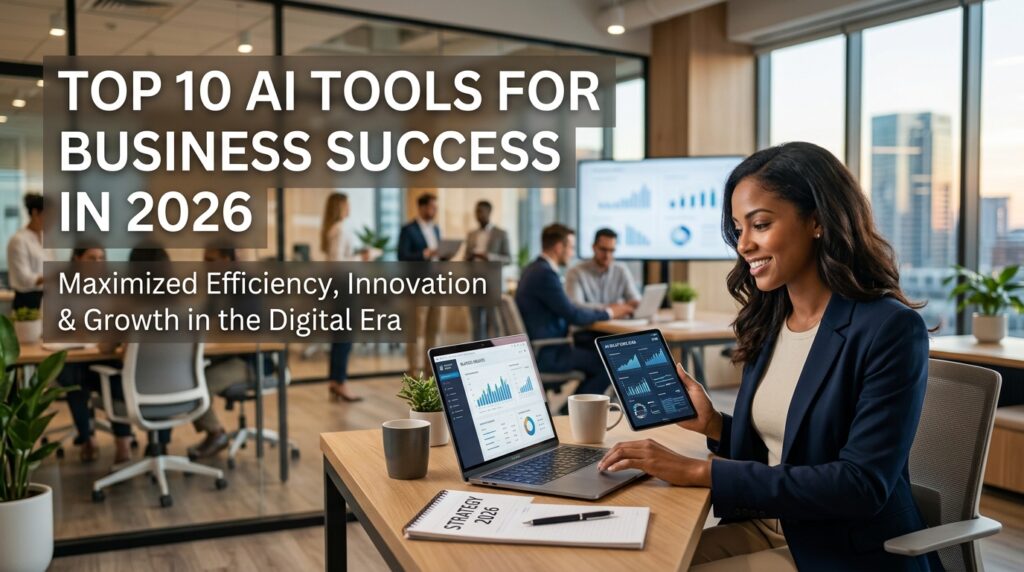
What follows is my curated list of the top ten AI tools for business success in 2026. These are the tools I have seen deliver real results. They are the tools I recommend to the businesses I consult with. They are the tools that have survived the hype cycle and proven their worth.

Tool 1: ChatGPT Enterprise
ChatGPT Enterprise is the foundation upon which many businesses are building their AI strategy. It is not just a chatbot. It is a comprehensive AI platform that can handle everything from content creation to data analysis to customer support.
What makes ChatGPT Enterprise different from the consumer version is the enterprise-grade security and governance. You get dedicated infrastructure, data privacy guarantees, and administrative controls. Your data is not used to train the model. You can manage users, set usage policies, and monitor activity across your organization.
The capabilities in 2026 are extensive. ChatGPT Enterprise can process text, images, audio, and video. It can analyze uploaded files including PDFs, Word documents, Excel spreadsheets, and images. It can search the web for real-time information. It can generate images using DALL-E. It can reason through complex problems step by step. And it can maintain context across conversations.
For businesses, the real value is in the integration capabilities. ChatGPT Enterprise can connect to your existing systems through APIs. You can build custom GPTs that are trained on your specific data. You can create workflows that automate repetitive tasks. The potential applications are almost limitless.
I have seen businesses use ChatGPT Enterprise for content creation, customer support, research, analysis, decision making, and product development. The companies that are getting the most value are the ones that have built custom solutions around the platform rather than just using it as a simple chatbot.
Why it made the list: ChatGPT Enterprise is the most versatile AI platform available. It can handle almost any business use case. The enterprise-grade security and governance make it suitable for organizations of any size. And the integration capabilities mean it can become the foundation of your AI strategy.
Tool 2: Claude for Business
Claude has carved out a strong reputation for handling long-form content with a level of depth and nuance that sets it apart. For businesses that need careful reasoning, long-form writing, or complex analysis, Claude is often the better choice than ChatGPT.
The one million token context window is a game-changer for businesses. You can feed Claude entire documents, research papers, or extensive conversations and it will maintain perfect contextual awareness. This makes it invaluable for legal analysis, contract review, research synthesis, and any task that requires processing large amounts of information.
Claude’s language quality is also superior for certain use cases. The prose flows with a natural cadence that does not have the robotic, repetitive AI smell that sometimes characterizes other models. This makes it ideal for content that needs to sound human, like white papers, thought leadership, and customer communications.
Anthropic has positioned Claude as the ethical AI choice. The constitutional AI approach means the model is designed to be helpful, harmless, and honest. For businesses that are concerned about AI ethics, this is a significant differentiator.
Claude for Business includes enterprise-grade security, administrative controls, and integration capabilities. You can build custom solutions around the platform and integrate it with your existing systems.
I have seen businesses use Claude for legal document review, contract analysis, research synthesis, white paper writing, and complex problem solving. The companies that are getting the most value are the ones that need deep reasoning and careful analysis rather than just content generation.
Why it made the list: Claude excels at reasoning and analysis in ways that other models cannot match. The one million token context window is a significant advantage for businesses that need to process large amounts of information. The language quality is superior for content that needs to sound human.

Tool 3: Salesforce Agentforce
Salesforce Agentforce is the gold standard for companies already living inside the Salesforce ecosystem. It builds service and sales agents that resolve cases directly within Salesforce. If you are a Salesforce shop, this is the path of least resistance.
What makes Agentforce different from generic AI tools is the deep integration with Salesforce data. The agents have access to your customer data, sales history, and service records. They can resolve cases, qualify leads, and provide personalized recommendations based on actual customer information.
The capabilities in 2026 are impressive. Agentforce can handle complex customer service inquiries, qualify leads, schedule appointments, and even close sales. The agents are designed to work alongside human employees, handling routine tasks so your team can focus on high-value work.
Pricing starts at one hundred and twenty five dollars per user per month, or roughly ten cents per action. The ROI is clear for businesses that are already paying for Salesforce. The cost is comparable to hiring additional staff, but the agents work twenty-four seven.
I have seen businesses achieve significant results with Agentforce. One company achieved seventy percent deflection, meaning the agents resolved issues without human intervention. Another company reached forty percent faster resolution times. A third hit sixty five point eight percent automation.
Why it made the list: Agentforce is the most effective AI solution for companies already using Salesforce. The deep integration with customer data means the agents are more effective than generic alternatives. The ROI is clear and measurable.
Tool 4: Microsoft Copilot
Microsoft Copilot is the obvious choice for Microsoft 365 companies. It lets teams build agents across Teams and SharePoint without leaving the Microsoft ecosystem. The real advantage is that it is included with Microsoft 365 Copilot, which runs thirty dollars per user per month.
Copilot is embedded directly into the tools your team already uses. It is in Word, Excel, PowerPoint, Outlook, and Teams. Your team does not need to learn a new interface or switch between applications. The AI is integrated into their workflow.
The capabilities are extensive. Copilot can draft emails, summarize meetings, create presentations, analyze data, and automate workflows. The context awareness is impressive. It understands the documents you are working on, the conversations you are having, and the context of your work.
For businesses, the real value is in the productivity gains. Studies show that Copilot users are significantly more productive than non-users. Tasks that used to take hours now take minutes. The quality of work improves because the AI handles the routine tasks and lets humans focus on the high-value work.
I have seen businesses use Copilot for email management, meeting summarization, presentation creation, data analysis, and workflow automation. The companies that are getting the most value are the ones that have invested in training their teams on how to use the tool effectively.
Why it made the list: Copilot is the most integrated AI solution for Microsoft 365 companies. The integration into existing tools means no learning curve. The productivity gains are significant and measurable.
Tool 5: Notion AI
Notion AI is the AI-powered workspace that is transforming how teams collaborate and manage information. It is built into the Notion platform, which is already used by millions of teams for project management, documentation, and knowledge sharing.
What makes Notion AI different from other AI tools is the context. It understands your workspace. It knows your projects, your documents, and your team. When you ask for help, it can draw on that context to provide relevant, actionable information.
The capabilities include content generation, summarization, task automation, and intelligent search. You can ask Notion AI to draft a project plan, summarize a meeting, automate a workflow, or find information across your workspace. The responses are tailored to your specific context.
For businesses, the real value is in knowledge management. Notion AI helps teams capture, organize, and find information. Instead of searching through dozens of documents, you can ask a question and get a synthesized answer. This is a game-changer for teams that struggle with information silos.
I have seen businesses use Notion AI for project planning, documentation, knowledge management, and team collaboration. The companies that are getting the most value are the ones that have built comprehensive workspaces and use Notion AI as the interface to that knowledge.
Why it made the list: Notion AI is the best AI solution for knowledge management and team collaboration. The deep integration with the Notion workspace means the AI understands your context. The intelligent search and summarization capabilities are transformative.
Tool 6: Glean
Glean is the enterprise knowledge search tool that finds answers across all your work apps. It is designed for organizations that suffer from information silos and scattered knowledge. Instead of searching through dozens of different tools, you ask Glean and it finds the answer.
Glean connects to all your work applications: Gmail, Slack, Google Drive, Salesforce, Confluence, and more. It indexes all the information and makes it searchable from one interface. When you ask a question, Glean finds the answer across all your apps.
The AI capabilities are impressive. Glean does not just search for keywords. It understands the meaning of your question and finds relevant information even if it does not use the exact words. It synthesizes information from multiple sources to provide comprehensive answers.
For businesses, the real value is in time savings. Studies show that employees spend a significant portion of their workday searching for information. Glean reduces that time dramatically. It also improves decision making because teams have access to all relevant information.
I have seen businesses use Glean to reduce information search time, improve decision making, and break down information silos. The companies that are getting the most value are the ones with complex information landscapes and distributed teams.
Why it made the list: Glean is the best solution for enterprise knowledge search. The integration with all work apps makes it comprehensive. The AI understanding of meaning makes it more effective than traditional search tools. The reported pricing of fifty to seventy five dollars per user per month is reasonable for the value provided.

Tool 7: n8n
n8n is the undisputed king of open-source workflow automation. Think of it like a much more powerful, self-hostable version of Zapier or Make. It combines a visual canvas with custom code, runs self-hosted or in the cloud, and connects to over four hundred apps and fifteen hundred plus integrations.
What makes n8n different from other automation tools is the pricing. Zapier and Make charge per operation, which can get expensive fast. n8n charges a fixed infrastructure cost. For businesses with significant automation needs, the savings are substantial.
The capabilities in 2026 are impressive. n8n has an AI Agent node that lets you build AI agents directly inside your workflow. Connect a chat model and one or more tools, and the agent decides which tools to call to complete a task. An AI agent in n8n is an autonomous system that receives data, makes rational decisions, and acts within its environment.
For businesses, the real value is in automation. n8n can automate repetitive tasks, connect disparate systems, and orchestrate complex workflows. The AI Agent node takes this to the next level by allowing agents to make decisions and adapt to changing conditions.
I have seen businesses use n8n for email triage, customer support, content publishing, data querying, research automation, and multi-agent orchestration. The companies that are getting the most value are the ones with significant automation needs and the technical expertise to build custom workflows.
Why it made the list: n8n is the most cost-effective automation platform for businesses with significant automation needs. The AI Agent node adds agentic capabilities that go beyond traditional workflow automation. The open-source nature means no vendor lock-in.
Tool 8: Zapier
Zapier remains the best overall for cross-team AI orchestration. It has the widest integration library and the most mature ecosystem. If you need to connect AI agents to thousands of different apps without writing code, Zapier is still the safest bet.
What makes Zapier different from n8n is the ease of use. The no-code interface means anyone on your team can build automations without technical expertise. The integration library is the most extensive in the industry. If there is an app, Zapier probably integrates with it.
The capabilities in 2026 have expanded significantly. Zapier now includes AI capabilities that let you build AI agents and integrate them with your automations. You can connect ChatGPT, Claude, and other AI tools to your workflows.
For businesses, the real value is in accessibility. Zapier democratizes automation. Anyone on your team can build automations. The integration library means you can connect almost any tool. The AI capabilities add intelligence to your automations.
I have seen businesses use Zapier for almost everything: lead generation, customer support, marketing automation, project management, and more. The companies that are getting the most value are the ones that have trained their teams to use the tool effectively.
Why it made the list: Zapier is the most accessible automation platform. The no-code interface means anyone can build automations. The integration library is the most extensive in the industry. The AI capabilities add intelligence to your workflows.
Tool 9: HubSpot AI
HubSpot AI is the AI-powered CRM that is transforming how businesses manage customer relationships. It is built into the HubSpot platform, which is already used by millions of businesses for sales, marketing, and customer service.
What makes HubSpot AI different from other CRM solutions is the integration of AI throughout the platform. AI is not a separate tool. It is embedded into every part of the CRM. The AI helps you write emails, prioritize leads, automate tasks, and gain insights from your data.
The capabilities include email generation, lead scoring, task automation, predictive analytics, and intelligent recommendations. The AI analyzes your data and provides insights that help you make better decisions.
For businesses, the real value is in sales efficiency. HubSpot AI helps sales teams work faster and smarter. The AI writes emails, prioritizes leads, and automates tasks. Sales representatives spend less time on administrative work and more time selling.
I have seen businesses use HubSpot AI to increase sales productivity, improve lead conversion, and automate customer service. The companies that are getting the most value are the ones that have fully integrated HubSpot into their sales and marketing operations.
Why it made the list: HubSpot AI is the best AI-powered CRM for businesses that need sales and marketing automation. The integration of AI throughout the platform is seamless. The value in sales efficiency is clear.
Tool 10: Grammarly Business
Grammarly Business is the AI-powered writing assistant that is improving communication across organizations. It is used by millions of professionals to write clearer, more effective communications.
What makes Grammarly Business different from the consumer version is the enterprise-grade features. You get team analytics, centralized billing, style guides, and brand voice customization. The AI is trained on your organization’s communication standards.
The capabilities include grammar checking, style suggestions, tone analysis, clarity improvements, and brand voice enforcement. Grammarly analyzes your writing and suggests improvements that make it clearer, more professional, and more effective.
For businesses, the real value is in communication quality. Poor communication costs businesses time and money. Grammarly helps teams write clearer, more effective communications. The brand voice enforcement ensures consistency across all team communications.
I have seen businesses use Grammarly Business to improve communication quality, enforce brand standards, and reduce writing time. The companies that are getting the most value are the ones that have integrated Grammarly into their communication workflow.
Why it made the list: Grammarly Business is the best AI writing assistant for businesses. The enterprise features and brand voice customization make it suitable for organizations of any size. The improvement in communication quality is measurable.
How to Choose the Right Tools for Your Business
With so many options, choosing the right tools can feel overwhelming. Here is the framework I use when helping businesses select AI tools.
Start with your problem. What are you trying to solve? Do not start with the tool. Start with the problem. Identify the specific pain points in your business. Then look for AI solutions that address those pain points.
Evaluate the integration. Does the tool integrate with your existing systems? The best AI tool in the world is useless if it does not work with your existing technology stack.
Consider the learning curve. How long will it take your team to learn the tool? A powerful tool that is difficult to use is less valuable than a simpler tool that your team will actually use.
Look at the pricing. What is the total cost of ownership? Consider not just the subscription cost, but also the implementation cost, training cost, and ongoing maintenance cost.
Start small. Do not roll out a tool to your entire organization at once. Start with a pilot program. Test the tool with a small group. Learn what works and what does not. Then scale up.
Measure the results. How will you measure success? Define clear metrics before you implement the tool. Track those metrics to see if the tool is delivering value.
The Most Important Thing I Learned
If I could go back and tell my past self one thing, it would be this: the best AI tool is the one your team actually uses.
The most impressive tool in the world is useless if it sits unused. The tools that deliver results are the ones that integrate seamlessly into existing workflows, solve real problems, and are easy to use. The companies that succeed with AI are the ones that focus on adoption, not just acquisition.
The tools themselves are powerful, but they need people to use them effectively. Invest in training. Build workflows around the tools. Create a culture that embraces AI. That is how you get real results.
Conclusion
The AI tools I have shared with you are the ones that have proven their worth in real business environments. They solve real problems. They integrate into existing workflows. They deliver measurable results.
The landscape is changing fast. New tools are emerging every day. But the fundamentals remain the same. Start with your problem. Evaluate the options. Implement thoughtfully. Measure the results. Iterate and improve.
The businesses that succeed with AI are not the ones with the most tools. They are the ones with the right tools and the right approach. They are the ones that focus on solving real problems and delivering real value.
Go build something that drives real business results.
Which AI tool are you most excited to implement in your business? Drop me a comment or shoot me an email. I would genuinely love to hear about your journey.

Other Articles

The Ultimate AI Tool Comparison Guide (2026)
How to Use ChatGPT Effectively: A 2026 Guide