




I spent my first six months with AI getting mediocre results and blaming the technology. Then I realized the problem was not the AI. It was me. Here is everything I learned about writing prompts that actually work.
My Six Months of Wasted Prompts
Let me tell you about the most embarrassing moment of my AI journey. I had been using ChatGPT for about three months and I was convinced it was overrated garbage. Every response felt generic, shallow, and completely useless. I complained to a friend who was getting incredible results from the exact same tool. He asked me to show him my prompts. I typed in “Write a blog post about AI tools” and hit enter. He just stared at me. Then he laughed and said, “That is your problem. You are treating it like Google. It is not Google. It is an intern who needs specific instructions.”
That conversation changed everything. I realized I had been approaching AI completely wrong. I was expecting magic from vague instructions. The technology was not the problem. My communication was the problem. I had been treating a sophisticated language model like a search engine instead of a reasoning partner.
The shift I experienced over the next six months was dramatic. I went from generic, forgettable outputs to content that actually impressed clients. I went from spending hours editing AI drafts to delivering work that needed minimal polish. I went from frustrated user to someone who could reliably get exactly what I wanted from any model I used.
Here is the honest truth that nobody tells you. Prompt engineering is not some mystical dark art that requires a PhD in linguistics. It is simply the skill and process of giving an AI tool clear instructions so it can produce accurate, useful, and personalized responses. It is how you design and refine the instructions you give AI models to get outputs that are accurate, relevant, and actually useful. The quality of what you put in determines the quality of what comes out. The more precise and intentional your input, the more useful and accurate the result.
What follows is the system I developed after hundreds of hours of experimentation. I am going to walk you through the fundamentals of how AI models process prompts, the specific techniques that produce consistently better results, and the common mistakes that keep most people stuck in mediocrity.
What Is Prompt Engineering, Really?
Before you can write better prompts, you need to understand what prompt engineering actually is. The term sounds technical and intimidating, but the concept is simple.
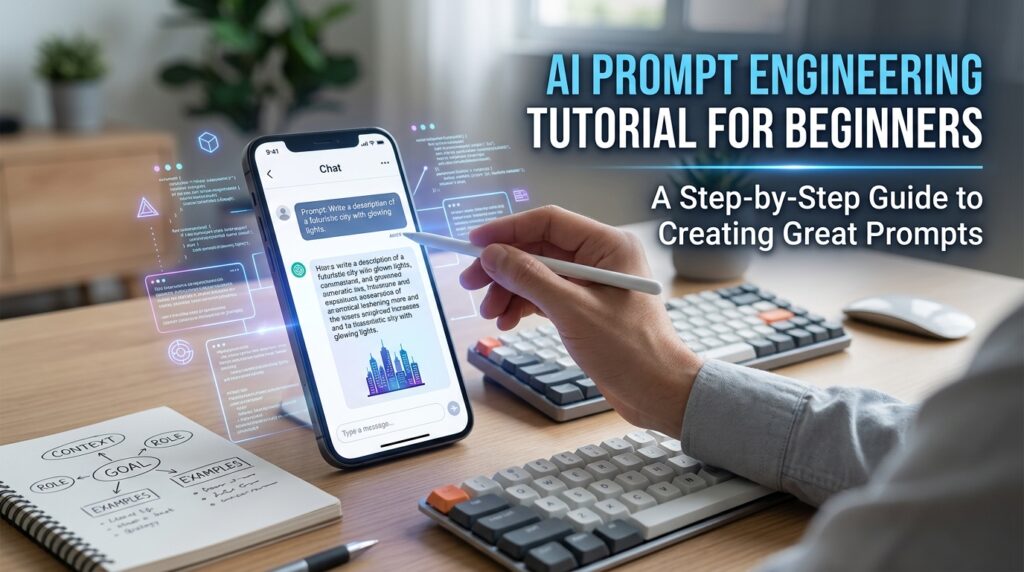
Prompt engineering is the practice of writing clear, structured instructions that help AI models produce the response you actually want. It is the art and science of designing and optimizing prompts to guide AI models towards generating the desired responses. By carefully crafting your prompts, you provide the model with context, instructions, and examples that help it understand your intent and respond in a meaningful way.
Think of it like this. When you ask a human for help, you give them context about what you need. You explain the situation. You provide examples if necessary. You clarify what you do and do not want. Prompt engineering is the same thing, but for AI. You are not just asking a question. You are providing a complete set of instructions that guide the AI toward the output you need.
Here is why this matters. AI models are trained on massive amounts of data, but they have no understanding of your specific situation, your audience, your goals, or your preferences unless you tell them. Vague prompts produce generic results because the model defaults to the most statistically common response in its training data. Specific prompts produce specific results because you have narrowed the model’s search space.
The good news is that anyone can learn prompt engineering. You do not need to be a programmer. You do not need to understand how the underlying technology works. You just need to learn how to communicate clearly and specifically with a system that processes language differently than humans do.
Why Prompt Engineering Matters in 2026
You might be wondering why you should invest time in learning prompt engineering. The short answer is that it is the single most valuable skill you can develop in the AI era.
The numbers tell a compelling story. According to the 2025 Stack Overflow Developer Survey, eighty four percent of developers use or plan to use AI tools, and fifty one percent use them daily. But only twenty nine percent trust AI output to be accurate. That trust gap is the real problem. People are using these tools but they are not getting reliable results. The difference between reliable results and unreliable ones is almost always the prompt.
Gartner predicts that by the end of 2026, forty percent of enterprise applications will feature task-specific AI agents. That means AI is not just a novelty anymore. It is becoming embedded in how work gets done across every industry. The people who know how to communicate effectively with AI will have a massive advantage over those who do not.
Here is the thing. Prompt engineering is not just about getting better answers. It is about getting answers faster. It is about reducing the number of iterations you need to reach a good result. It is about eliminating the frustration of generic, useless outputs. It is about making AI a reliable partner rather than a frustrating experiment.
The gap between those who can prompt effectively and those who cannot is widening every day. The people who learn this skill are earning roughly forty percent more per hour than those who do not. It is not because they have access to better tools. It is because they know how to use the tools they have.
The Anatomy of a Great Prompt
A well-structured prompt has several key components. You do not need to include all of them every time, but the more components you include, the better your outputs will be.
Goal and Outcome is the first and most important component. State clearly what you want and what a good result looks like. Instead of “Write a blog post,” try “Write a blog post that explains prompt engineering to absolute beginners in a conversational, friendly tone.”
Context is what the model needs to understand your situation. AI performs best when it understands the context. Explain who the output is for, what problem you are solving, and any relevant background information. Instead of “Write a sales email,” try “Write a sales email to a small business owner who has been struggling with customer service response times.”
Role and Persona is one of the most effective techniques I have found. Asking the AI to take on a specific role can dramatically improve the quality of the response. Instead of “Summarize this article,” try “You are an experienced editor who specializes in distilling complex information into clear, actionable takeaways. Summarize this article.”
Task and Instructions should be specific and actionable. Scope one task per request. Break complex requests into smaller steps. Instead of “Analyze this business plan,” try “Analyze this business plan step by step. First, evaluate the market opportunity. Second, assess the competitive landscape. Third, review the financial projections.”
Structure and Format tells the model exactly how you want the output organized. Specify the format you want. Instead of “Write a blog post,” try “Write a blog post with an attention-grabbing introduction, five numbered sections, a comparison table, and a conclusion with a call to action.”
Constraints set boundaries that prevent generic or inappropriate outputs. Define what you do not want as well as what you do want. Instead of “Write a product description,” try “Write a product description that does not use hype words like revolutionary or game-changing. Keep it under one hundred and fifty words.”
Examples are incredibly powerful. Show the AI what good output looks like. Instead of “Write a funny product description,” try “Write a product description in the style of this example: [insert example]. It should be humorous, slightly irreverent, and highlight the product’s key features in an entertaining way.”
Core Prompting Techniques for Beginners
Once you understand the anatomy of a good prompt, these techniques will take your prompting to the next level.
Zero-Shot Prompting is the most basic technique. You give the model a task without providing any examples. This works well for simple, straightforward tasks where the model has enough training data to understand what you want. “Write a summary of this article” is a zero-shot prompt.
Few-Shot Prompting involves providing examples in your prompt to show the model what you want. This is incredibly effective for tasks that require a specific style, format, or approach. Instead of “Write a product description,” you provide two or three examples of product descriptions you like and then ask for a new one in the same style.
Chain of Thought Prompting is the technique that changed everything for me. Instead of asking for the final answer, ask the model to walk through its reasoning step by step. This forces the model to engage in reasoning rather than pattern matching. The outputs are more thoughtful, more accurate, and easier to verify. If the model makes a mistake, you can see exactly where it went wrong.
Role Prompting assigns a specific persona to the model. This is one of the most effective techniques because it accesses the language patterns associated with that role from the model’s training data. Instead of “Write a blog post,” try “You are an experienced AI consultant with five years of experience helping businesses implement AI solutions. Write a blog post that explains prompt engineering to busy executives.”
Structured Output Prompting tells the model exactly how you want the response formatted. This is essential when you need the output in a specific format for further processing. Instead of “List five AI tools,” try “List five AI tools in a table with columns for tool name, best use case, pricing, and key feature.”
Advanced Techniques for Better Results
Once you have mastered the basics, these advanced techniques will take your prompting to the next level.
Iterative Refinement is the practice of generating, reviewing, and refining your prompts based on the results you get. Do not expect perfection on the first attempt. Generate a draft, review it critically, and then refine your prompt based on what you see. The best prompt for a specific task is rarely the first one you try.
Conversational Prompting treats the AI interaction like a conversation rather than a one-off request. You start with a basic prompt, review the response, and then ask follow-up questions or request revisions. This is particularly effective for complex tasks that benefit from back-and-forth refinement.
Negative Prompting tells the model what you do not want. This is especially important for preventing common problems. Instead of “Write a product description,” try “Write a product description that does not use hype words, avoids technical jargon, and focuses on practical benefits rather than features.”
Persona Layering involves building a prompt that layers multiple personas or perspectives. This is particularly effective for complex analysis that benefits from multiple viewpoints. “You are three experts reviewing this business plan. First, a venture capitalist focused on financial viability. Second, an industry expert focused on market positioning. Third, an operations specialist focused on execution feasibility. Analyze from each perspective and then synthesize the findings.”
System Prompting for platforms that support it defines the model’s role and parameters for the entire conversation. This creates consistency across multiple interactions. A good system prompt might include the model’s persona, its knowledge boundaries, its communication style, and any specific rules it should follow.
Example-Driven Prompting involves providing concrete examples of what you want. This is one of the most powerful techniques because it gives the model a clear reference point. Include three to eight input-output examples in your prompt to show the model exactly what you are looking for.
Common Mistakes and How to Fix Them
I have made all of these mistakes and I have watched countless others make them too. Here is how to avoid them.
Mistake one: Being too vague. This is the most common mistake and the easiest to fix. Vague prompts produce useless output. Add specifics to every prompt. Include the role, the task, the context, and the constraints. Instead of “Help me with my business,” try “Help me create a marketing plan for my small bakery that targets local customers through social media.”
Mistake two: Being too long and unfocused. While you want to be specific, you do not want to be bloated. Include relevant information and remove everything that is not essential. Scope one task per request. If you have multiple tasks, break them into separate prompts.
Mistake three: Forgetting to provide context. AI performs best when it understands the situation. Do not assume the model knows anything about your specific situation. Explain who the output is for, what problem you are solving, and any relevant background.
Mistake four: Ignoring the model’s limitations. AI models have limitations. They hallucinate information. They have limited context windows. They reflect biases present in their training data. Understanding what these tools cannot do is as important as understanding what they can do.
Mistake five: Giving up too quickly. If your first prompt does not produce great results, refine it. The difference between a good prompt and a great prompt is often subtle but significant. Iterate. Experiment. Learn from what works and what does not.
Mistake six: Forgetting to verify. AI models make mistakes. Always verify factual claims, check calculations, and review outputs carefully before using them professionally.
Model-Specific Prompting Strategies
Different models respond differently to different prompting approaches. Here is what I have learned about each major platform.
ChatGPT excels at step-by-step instructions. The more detailed and structured your prompt, the better the output. Use bullet points, numbered lists, and explicit formatting instructions. ChatGPT also responds well to persona-based prompts. Assigning a role produces significantly better results. Be explicit about length. If you do not specify length, the model often produces outputs that are too short or too long for your needs.
Claude excels at nuanced reasoning and long-form analysis. The one million token context window means you can provide extensive background information and Claude will maintain perfect contextual awareness. Claude responds exceptionally well to examples. Providing sample outputs or reference texts dramatically improves the consistency and quality of the results. Use brackets for emphasis and performance cues. Words like [excited], [thoughtful], or [warm] give the model signals about tone and delivery.
Gemini excels at multimodal tasks and integration with Google’s ecosystem. The model handles image, text, audio, and video inputs seamlessly. Gemini responds well to concise prompts. The model’s language is direct and efficient, making it ideal for technical writing, data analysis, and research tasks.
Building a Prompt Library
One of the smartest things I ever did was start building a prompt library. Instead of rewriting prompts from scratch, I save and refine the best ones for reuse.
Start with a folder structure organized by task type. Content writing prompts in one folder. Research prompts in another. Coding prompts in another. Email prompts in another. Within each folder, include the prompt, the output it produced, and any notes about what worked and what did not.
Over time, your prompt library becomes a valuable asset. You will find yourself reaching for proven prompts rather than starting from scratch every time. You will also notice patterns in what works, which will improve your prompting skills across the board.
The best prompts are the ones you have tested and refined. Do not just save a prompt because it worked once. Save it because it works consistently across different contexts and with different models.
The Most Important Thing I Learned
If I could go back and tell my past self one thing, it would be this: prompt engineering is not about finding secret incantations. It is about communicating clearly with a system that processes language differently than humans do.
The principles are simple. Be specific about what you want. Provide the context the model needs. Use structure to organize the output. Include examples when possible. Refine based on results.
The difference between mediocre outputs and exceptional ones is rarely the model. It is the prompt. I learned this the hard way after months of frustration. But once I understood the principles, everything changed.
The Google Prompt Engineering Course is beginner-friendly and practical. There are also excellent resources like the Prompt Engineering Deep Dive on GitHub, a hands-on playground for learning prompt engineering from the basics. But the best way to learn is to practice. Open a tool. Type a prompt. Review the output. Refine your prompt. Repeat.
Conclusion
Prompt engineering is the single most valuable skill you can develop in the AI era. It is not complicated. It does not require a computer science degree. It requires clarity, specificity, and a willingness to iterate.
The tools are powerful, but they need you to direct them effectively. The quality of what you put in determines the quality of what comes out. The more precise and intentional your input, the more useful and accurate the result.
Start with one tool. Master the basics. Write clear, specific prompts. Provide context. Use structure. Include examples. Iterate based on results. Build a library of proven prompts.
The gap between those who can prompt effectively and those who cannot is widening every day. The people who learn this skill are earning more, working faster, and producing better results. Do not be left behind.
Go write something that surprises you.
What is the one prompting technique you are most excited to try? Drop me a comment or shoot me an email. I would genuinely love to hear about your results.

Other Articles

Master AI Tools in 30 Days: A 2026 Roadmap
Step-by-Step AI Image Generation Guide (2026)