




I remember the first time I opened ChatGPT. I stared at the blank input box for a full five minutes, paralyzed. What was I supposed to ask? Was there a secret password? Did I need to know coding? The anxiety was real. Two years later, I am writing this guide to tell you that starting with AI is much easier than it looks. You do not need a computer science degree. You do not need to know Python. You just need curiosity and a willingness to experiment.
The Anxiety of Starting from Zero
Let me tell you about the most embarrassing moment of my AI journey. I had finally worked up the courage to open ChatGPT for the first time. I stared at that blinking cursor for what felt like an eternity. My mind went completely blank. I could not think of a single thing to ask. I closed the tab and told myself I would try again tomorrow. That tomorrow took three weeks to arrive.
The fear of not knowing where to start is real. Everyone feels it. The landscape seems overwhelming with endless tools, confusing terminology, and conflicting advice. Machine learning, deep learning, neural networks, natural language processing, generative AI, agentic AI, the list of buzzwords goes on forever. It feels like everyone else already knows what they are doing and you are the only one who does not.
Here is the honest truth that nobody tells you. Almost everyone using AI today started exactly where you are right now. Most people using these tools have no technical background. They are writers, marketers, business owners, students, and curious individuals who realized that AI could help them do their jobs better. The technology was built to be accessible, and in 2026, it is more accessible than ever.
The best time to start learning AI was two years ago. The second best time is today. The tools have matured to the point where you can accomplish meaningful work without understanding how the underlying technology works. Think of it like driving a car. You do not need to know how the engine works to get where you are going. You just need to know how to turn the key, press the pedals, and steer.
This guide is designed for anyone with zero or a small background in programming, AI, or machine learning who wants to become comfortable using AI tools in 2026. I am going to walk you through everything from understanding what AI actually is to using your first tools to building real skills. No jargon. No assumptions about what you already know. Just a clear, practical path forward.

What Is AI, Really?
Before we dive into using AI, we need to understand what it actually is. The term “artificial intelligence” gets thrown around so much that it has lost all meaning. Let me give you a definition that actually makes sense.
At its core, artificial intelligence is software that analyzes information, recognizes patterns, and generates responses or recommendations. It is computer technology designed to complete tasks that normally require some form of human thinking, things like recognizing patterns, understanding language, sorting information, making predictions, or creating new content.
Here is what is important to understand: AI does not think or feel. It works based on data and instructions. It is not conscious. It has no opinions. It is not trying to take over the world. It is a tool, like a very sophisticated calculator that processes language instead of numbers.
Think of it this way. When you use a calculator, you give it numbers and it gives you a result. When you use AI, you give it words and it gives you words back. The underlying mechanism is pattern recognition on a massive scale. The AI has been trained on billions of pages of text, code, images, and other data. When you ask it a question, it predicts what the most statistically likely response should be based on the patterns it has learned.
The field of AI is vast, but you do not need to understand all of it. The most important distinction for beginners is between traditional AI and generative AI. Traditional AI is about analysis and prediction, things like spam filters, recommendation algorithms, and fraud detection. Generative AI is about creation, things like writing text, generating images, producing videos, and writing code.
Almost everything you have heard about in the past few years falls under generative AI. ChatGPT writes text. Midjourney creates images. Claude analyzes documents. These are the tools you will actually use, and they are built to be accessible to people with no technical background.
Why Should You Care?
You might be wondering why you should invest time in learning AI tools. The short answer is that AI is becoming as fundamental as the internet. Knowing how to use it effectively will open doors in your career, your business, and your personal life.
The numbers tell a compelling story. According to the 2025 Stack Overflow Developer Survey, eighty four percent of developers use or plan to use AI tools, and fifty one percent use them daily. That is not a niche trend. That is a fundamental shift in how work gets done. The same pattern is emerging across every industry.
For students, AI tools can help with research, writing, studying, and understanding complex topics. For professionals, they can automate repetitive tasks, generate first drafts, analyze data, and improve communication. For entrepreneurs, they can create content, build prototypes, and handle customer service. For curious individuals, they can answer questions, generate creative ideas, and help you learn anything faster.
The question is no longer whether AI will affect your work. It is whether you will be someone who uses AI effectively or someone who gets left behind. The gap between those who adopt these tools and those who do not is widening every day. The people who learn to use AI strategically are earning roughly forty percent more per hour than those who do not.
But here is the thing. You do not need to become an AI expert to benefit from AI tools. You just need to become comfortable using them. Think of it like learning to use a spreadsheet. You do not need to become a data scientist to benefit from Excel. You just need to know enough to get your work done faster and better.
The Tools You Should Start With
When I first started, I made the mistake of trying to learn every tool at once. I had eight different tabs open, subscriptions to multiple services, and no idea what I was doing. Do not do that. Start with one tool. Master it. Then add others as you need them.
If you are new to AI, ChatGPT is usually the easiest free AI tool to begin exploring. OpenAI’s ChatGPT is the most accessible entry point. The free tier gives you access to GPT-5.5 with file and image uploads, data analysis, and image creation. You just need to create an account and start typing.
ChatGPT is the best all-purpose starting point. It handles everything from writing and brainstorming to research and analysis. The interface is simple and intuitive. You type a question or instruction, and it responds. You can refine your requests conversationally, adjusting and improving as you go. There is no wrong way to use it.
Once you are comfortable with ChatGPT, try Claude. Claude has carved out a strong reputation for handling long-form content with a level of depth and nuance that sets it apart. It is the tool I reach for when I need careful reasoning, long-form writing, or complex analysis. The free tier gives you about fifteen to forty messages every five hours with a two hundred thousand token context window, which means it can process very long documents.
Perplexity is another excellent starting point, especially for research. Unlike ChatGPT and Claude, Perplexity specializes in finding information with verifiable sources. When you ask a question, it searches the web and provides answers with citations. If you are researching a topic, writing an article, or fact-checking information, Perplexity is invaluable.
Here is my recommendation for your first week. Create a free account with ChatGPT. Spend an hour just playing with it. Ask it questions about things you are curious about. Ask it to help you plan a meal, write a social media post, or explain a concept you have always struggled with. The goal is not to produce anything important. The goal is to get comfortable with the interface and understand what the tool can do.
Your First Prompts
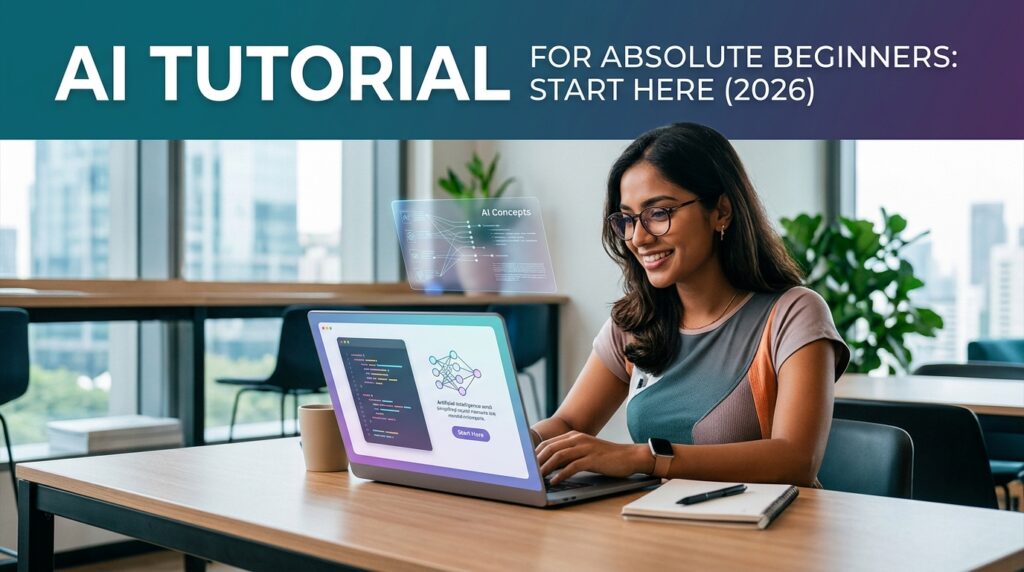
The biggest hurdle for most beginners is knowing what to ask. The blank box is intimidating. Let me give you some simple prompts to get started.
Start with informational questions. Ask “What is machine learning in simple terms?” or “Explain how AI chatbots work to a five year old.” These questions help you understand the technology while also showing you how the AI responds.
Move to practical tasks. Ask “Help me plan a weekly meal plan for a family of four” or “Write a professional email to schedule a meeting” or “Summarize this article in three bullet points.” These are tasks you would normally do yourself. The AI can do them faster.
Try creative requests. Ask “Write a short poem about autumn” or “Generate ten ideas for a small business” or “Create a character description for a fantasy novel.” These show you the creative capabilities of these tools.
The key insight I wish someone had told me is that you do not need to write perfect prompts. You can refine your requests conversationally. If the first response is not what you wanted, tell the AI what to change. “Make that more formal” or “Shorten that to fifty words” or “Add more detail about the second point.” The AI remembers the conversation and adjusts based on your feedback.
Over time, you will develop a sense of what works and what does not. You will learn to be more specific about what you want. You will understand which tools are best for which tasks. But that comes with practice. For now, just start typing.
A Simple Learning Roadmap
If you want to go beyond casual use and actually build skills, here is a simple roadmap that works for absolute beginners.
Week one: Get comfortable with the tools. Create accounts with ChatGPT, Claude, and Perplexity. Spend time with each one. Understand their strengths and weaknesses. ChatGPT for versatility. Claude for depth. Perplexity for research. Use them for everyday tasks. Write emails, plan meals, research topics, generate ideas.
Week two: Learn prompt fundamentals. Start paying attention to how you phrase your requests. Notice what produces good results and what produces mediocre ones. Experiment with adding context, specifying the format, and providing examples. The quality of what you put in determines the quality of what comes out.
Week three: Apply AI to real work. Identify a task you do regularly that could be accelerated with AI. Maybe it is writing, research, planning, or analysis. Use AI to help with that task. Compare the results to what you would produce on your own. Notice where AI helps and where it falls short.
Week four: Expand your toolkit. Based on what you have learned, add specialized tools. If you need images, try Canva Magic Studio or Leonardo.ai. If you need video, try HeyGen or InVideo. If you need automation, explore n8n or Zapier. The goal is not to learn everything. The goal is to build a toolkit that supports your specific needs.
The best learning resources for absolute beginners include structured courses like Generative AI Foundations for Absolute Beginners on Coursera, which walks you through the basics without requiring any prior technical knowledge. For those who prefer self-study, the No-Hype AI Learning Guide on GitHub provides a curated map of resources that actually deliver.
What to Learn Next
Once you are comfortable using AI tools, you might want to go deeper. Here is where to focus your energy.
Prompt engineering is the single most valuable skill you can develop. This is the art of communicating effectively with AI tools. The better you get at crafting prompts, the better results you will get. This is not about learning secret incantations. It is about being clear, specific, and thoughtful about what you ask for.
Understanding AI limitations is equally important. AI models make mistakes. They hallucinate information that sounds plausible but is completely false. They reflect biases present in their training data. They have limited context windows and cannot remember everything forever. Knowing what these tools cannot do is as important as knowing what they can do.
Agentic AI is the next frontier. Instead of just answering questions, AI agents can take action, browse the web, fill out forms, write code, and coordinate with other agents to accomplish multi-step tasks. Learning how to use agentic tools opens up entirely new possibilities for automation and productivity.
Building AI-powered products is where the real opportunities lie. You do not need to become a machine learning engineer. You just need to understand how to integrate AI capabilities into products and services. This is the skill that will define the next decade of work.
The Most Important Thing I Learned
If I could go back and tell my past self one thing, it would be this: stop waiting to feel ready. You will never feel ready. The technology is changing too fast. There will always be something new to learn. The only way to start is to start.
I wasted three weeks of my AI journey because I was too scared to type my first prompt. Do not make that mistake. Open ChatGPT right now. Type something. Anything. It does not matter what it is. The worst that can happen is you get a mediocre response. The best that can happen is you discover something amazing.
The people who are succeeding with AI are not the ones who waited until they understood everything. They are the ones who started experimenting, made mistakes, learned from them, and kept going. That is the only path that works.
Conclusion
Starting with AI in 2026 is easier than it has ever been. The tools are free, accessible, and remarkably capable. You do not need technical skills to get started. You just need curiosity and a willingness to experiment.
Create a free account with ChatGPT. Spend an hour playing with it. Ask questions. Try different prompts. See what works. Then try Claude. Then try Perplexity. Build a habit of using these tools for everyday tasks.
The best time to start was two years ago. The second best time is today. Open a tab. Create an account. Type your first prompt. The anxiety will fade after the first few messages. What you discover on the other side is worth the initial discomfort.
Go start your journey.

Other Articles

Step-by-Step AI Image Generation Guide (2026)
Top AI Tools for Developers to Use in 2026